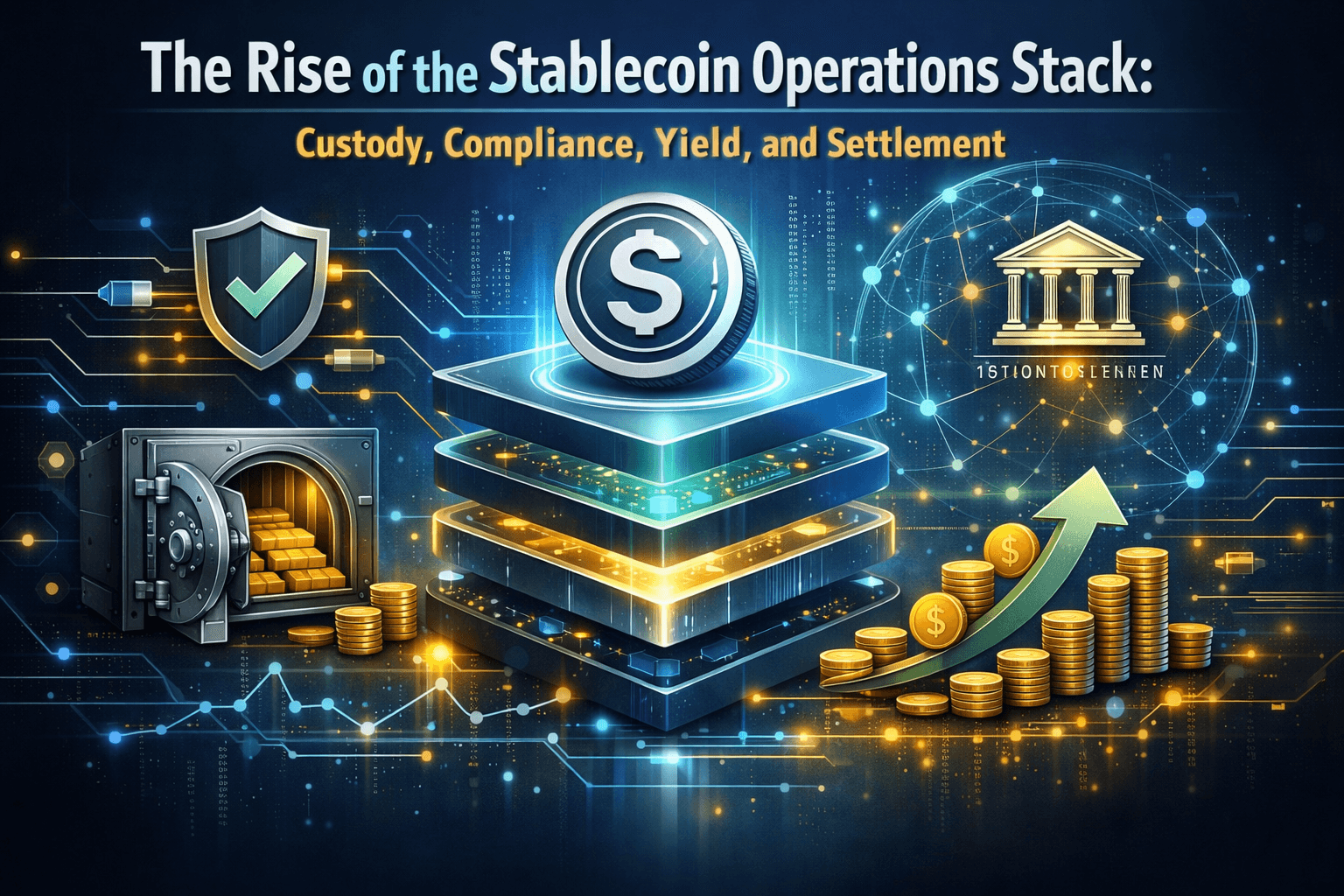
The financial infrastructure landscape is transforming faster than at any point since electronic banking emerged. At the center sits something most businesses don't yet understand but can't afford to ignore: the stablecoin operations stack.
This isn't about whether stablecoins will replace traditional payments. That question misses the point entirely. The real revolution is happening in how businesses handle every interaction with digital dollars, from the moment funds arrive until deployment and everything in between.
Stablecoins reached $308 billion in circulation by late 2025, with transaction volumes surpassing Visa and Mastercard combined in 2024. But volume tells only part of the story. What matters more is the emergence of complete operational infrastructure redefining what programmable money can do.
What Is the Stablecoin Operations Stack?
The stablecoin operations stack is the complete set of infrastructure layers enabling businesses to not just hold or transfer digital dollars, but make them programmable, productive, and compliant. It's the difference between having a checking account and having a complete financial operating system.
The stack consists of four critical layers addressing fundamental business needs:
Layer 1: Custody Infrastructure
Modern custody infrastructure looks radically different from simple wallet storage of two years ago. Traditional models forced businesses to choose between self-custody (managing private keys internally) or third-party custody (trusting external providers). Both created friction.
The evolution now is custody infrastructure integrating seamlessly with existing business systems. Major banks like BNY Mellon and JPMorgan offer institutional-grade custody services specifically designed for stablecoin operations. SoFi became the first national bank to launch fully reserved stablecoin infrastructure in December 2025, offering white-label custody solutions allowing fintechs and banks to maintain customer relationships while leveraging proven frameworks.
Modern custody infrastructure differs in recognizing that custody isn't standalone. It's a gateway to the entire operations stack. Leading providers offer API-first architectures allowing businesses to programmatically manage stablecoin balances without changing internal operations.
The key insight: custody solved purely for security is table stakes. Custody enabling the rest of the operational stack is strategic infrastructure.
Layer 2: Compliance Layer
Regulatory compliance historically blocked stablecoin adoption for traditional businesses. The GENIUS Act, signed into law July 2025, fundamentally changed this by establishing the first federal framework for payment stablecoins in the United States.
Under GENIUS Act requirements, stablecoin issuers must maintain 1:1 reserves in high-quality liquid assets, publish monthly attestations, and receive federal banking regulator approval. Hong Kong's Stablecoin Ordinance and Europe's MiCA regulations created similar frameworks globally.
But regulatory clarity is only the beginning. The compliance layer goes beyond meeting legal requirements to embedding compliance directly into financial operations.
Modern compliance infrastructure includes:
Travel Rule Automation: Instead of manually collecting and transmitting required information for cross-border transfers, leading platforms embed Travel Rule compliance directly into transaction flows. Data travels with payment, eliminating manual coordination.
Real-Time Sanctions Screening: Traditional banking processes sanctions checks in batches, creating settlement delays. Stablecoin compliance infrastructure runs real-time screening against OFAC and other sanctions lists, blocking prohibited transactions before execution while allowing legitimate payments to settle instantly.
Automated KYC/AML Integration: Rather than maintaining separate compliance processes for digital and fiat operations, advanced platforms unify identity verification across all payment channels.
Fireblocks reports fewer than one in five firms now cite regulation as a barrier to stablecoin adoption, down from 80% two years ago. This dramatic shift reflects not just regulatory clarity but maturation of tools operationalizing compliance automatically.
Layer 3: Yield Generation
This is where the stablecoin operations stack diverges most dramatically from traditional financial infrastructure. In conventional banking, money in business accounts earns minimal or zero interest. Capital required to run operations is fundamentally unproductive.
Stablecoin infrastructure changes this equation entirely.
The yield layer enables businesses to earn returns on operational capital without sacrificing liquidity. Through integration with DeFi protocols and regulated tokenized assets, stablecoins generate 4-14% annual percentage yields while remaining accessible for business operations.
Current yield sources include:
DeFi Lending Protocols: Platforms like Drift Protocol on Solana enable businesses to earn 6-9% APY by providing liquidity to decentralized lending markets. The key innovation is instant liquidity, funds can be deployed and withdrawn in the same transaction, eliminating traditional tradeoffs between yield and access.
Tokenized Treasury Bills: Regulated offerings like Franklin Templeton's BENJI and BlackRock's BUIDL provide 4-5% yields backed by U.S. government securities. These products offer institutional-grade safety while maintaining on-chain programmability.
Yield-Bearing Stablecoins: Emerging models like Ethena's USDe (which reached $13 billion circulation by September 2025) build yield generation directly into tokens. Holders automatically earn returns without additional deployment steps.
Automated Optimization: Infrastructure providers now offer yield aggregation automatically allocating capital across multiple sources based on risk-adjusted returns, current market conditions, and liquidity requirements.
The strategic implication is profound. Payment processing transforms from cost center into revenue opportunity. A business processing $10 million monthly in stablecoin transactions with 3-day average float generates $175,000 annually at 7% APY. That's revenue created purely through better capital efficiency.
PayPal's December 2025 announcement that PYUSD will support AI infrastructure financing with 4.5% yields on up to $1 billion in deposits demonstrates how major players recognize yield as core infrastructure.
Layer 4: Settlement Infrastructure
The settlement layer ties everything together by enabling actual business operations to run on stablecoin rails.
Traditional settlement involves multiple parties, batch processing, and day-long delays. Cross-border payments can take days or weeks to clear. This creates working capital requirements, introduces counterparty risk, and limits business velocity.
Stablecoin settlement infrastructure operates on fundamentally different principles:
24/7 Real-Time Settlement: Unlike banking systems closing nights and weekends, stablecoin infrastructure settles transactions continuously. Visa's launch of USDC settlement for U.S. financial institutions in December 2025 enables partner banks to settle network obligations in real-time rather than through traditional batch processing.
Atomic Settlement: Smart contract infrastructure allows complex multi-party transactions to execute atomically, either all steps complete simultaneously or none execute. This eliminates principal risk and need for trusted intermediaries.
Programmable Conditions: Settlement can include business logic traditional rails can't support. Release funds when shipping confirmation arrives. Split payments automatically between multiple recipients. Implement dynamic discounting based on early payment.
Cross-Border Unification: Stablecoins treat domestic and international payments identically. A transfer from New York to Singapore executes with same speed and cost as payment across town.
Real-World Applications
Payment Service Providers
Traditional payment processors maintain significant stablecoin balances between customer deposits and merchant payouts. Under conventional infrastructure, this float earns nothing.
Companies integrating the complete operations stack now generate substantial revenue from previously idle capital. A processor handling $50 million monthly volume with 5-day average settlement window can deploy capital to yield-generating protocols, earning approximately $583,000 annually at 7% APY.
The operations stack makes this possible without changing customer experience or introducing additional risk. Custody remains under processor control. Compliance happens automatically through embedded Travel Rule infrastructure. Yield optimization occurs programmatically based on current market conditions.
B2B Marketplaces
Wholesale and B2B platforms face a fundamental trust problem: buyers want assurance sellers will deliver before releasing payment, while sellers need payment assurance before shipping goods.
Traditional escrow services charge 1-3% of transaction value and lock funds unproductively during fulfillment. The stablecoin operations stack transforms this entirely.
Consider a $500,000 wholesale order with 45-day fulfillment. Using programmable settlement infrastructure, the platform can accept payment in any stablecoin, hold funds in escrow earning 7% APY during fulfillment, release payment automatically when IoT shipping data confirms delivery, and generate $4,300 in yield on a single transaction.
Instead of charging escrow fees, platforms can share yield with buyers and sellers, creating revenue from payments while improving customer economics.
Corporate Treasury
CFOs managing traditional treasury operations face persistent dilemmas. Keep cash liquid in low-yield accounts to meet operational needs, or invest in higher-yielding instruments sacrificing availability?
The stablecoin operations stack eliminates this false choice. Several Fortune 500 companies now run hybrid treasury operations combining traditional banking with stablecoin infrastructure. Operational cash flows through custody accounts integrated with yield protocols. Funds remain instantly accessible for business payments while continuously earning returns.
JPMorgan's stablecoin infrastructure has processed over $1.5 trillion in transactions, demonstrating institutional appetite for programmable treasury operations.
The Infrastructure Competition
Traditional Banks: Entering Through Custody
Major financial institutions use custody services as their entry point. BNY Mellon agreed to hold custody of Ripple's stablecoin reserves in July 2025. Goldman Sachs, Citigroup, and Deutsche Bank announced custody infrastructure development.
For banks, custody aligns naturally with existing compliance frameworks and trust relationships. However, most traditional banks aren't building complete operations stacks. They're providing foundational custody infrastructure while relying on partners for yield optimization and programmable settlement.
The GENIUS Act's prohibition on stablecoin issuers paying interest creates interesting dynamics. Banks can issue compliant stablecoins but cannot offer yield directly. This regulatory separation creates partnership opportunities with infrastructure providers specializing in yield optimization.
Payment Giants: Orchestrating Settlement
Stripe's $1.1 billion acquisition of Bridge in February 2025 represented the largest crypto acquisition by a major payments company. Mastercard's rumored $2 billion acquisition of zerohash's crypto capabilities demonstrates how payment networks view stablecoin infrastructure as strategic.
These players focus on settlement and compliance layers. Visa's global stablecoin settlement program reached $3.5 billion in annualized volume by November 2025, enabling banking partners to settle cross-border transactions directly on public blockchains.
The key insight: payment networks aren't replacing fiat rails. They're making existing infrastructure blockchain-capable, enabling instant stablecoin settlement while maintaining compliance.
Infrastructure Specialists: Building the Complete Stack
A new category of companies provides complete stablecoin operations infrastructure rather than focusing on single layers. These platforms offer custody-agnostic architectures working with existing wallet providers while adding yield optimization, programmable settlement, and automated compliance.
This approach addresses a critical market gap. Banks provide custody but not yield. DeFi protocols provide yield but not enterprise compliance. Payment processors handle settlement but don't optimize capital efficiency. Complete stack providers unify all layers into coherent operational infrastructure.
Why Now? The Convergence
Regulatory Clarity Removes Uncertainty
The GENIUS Act provides the first federal framework for stablecoin issuance in the United States. Europe's MiCA regulations became fully operational in 2025. Hong Kong's Stablecoin Ordinance launched August 2025 as a regional benchmark.
This regulatory clarity eliminates the primary objection traditional businesses cited for avoiding stablecoins. Compliance teams can now implement stablecoin infrastructure within defined legal frameworks.
Technical Infrastructure Reaches Enterprise Grade
Blockchain infrastructure has matured dramatically. Solana processes thousands of transactions per second at fractional-cent costs. Ethereum's layer-2 networks offer similar performance improvements.
Security reached institutional standards through formal verification, comprehensive auditing, and battle-testing under real-world conditions.
Market Demand Creates Pull
84% of institutional investors plan crypto exposure in 2025. 81% of SMBs express interest in stablecoin business applications. This isn't speculative interest, it's operational demand driven by tangible benefits.
Businesses recognize competitors implementing stablecoin operations gain structural advantages. Faster settlement means better cash flow. Yield on operational capital improves margins. Programmable payments enable business models impossible under traditional infrastructure.
The Multi-Stablecoin Future
The stablecoin landscape is fragmenting rapidly. What started with USDC and USDT has exploded into dozens of institutional issuances. PayPal's PYUSD grew 150% in 2025 to reach $1.4 billion. Western Union launched USDPT. Phantom's CASH leverages 15 million wallet users.
Projections suggest 200-500 institutional stablecoins by 2027. This fragmentation creates operational complexity demanding sophisticated infrastructure.
Businesses will need to accept multiple stablecoins from customers, optimize yield across different tokens with varying characteristics, route payments through the most efficient stablecoin for each transaction, and navigate different compliance requirements per issuer.
This complexity is exactly where operations stack infrastructure becomes essential. Manual management is impossible at scale. The companies building this orchestration layer today will be indispensable in the fragmented stablecoin economy of 2027 and beyond.
Strategic Implications
For Payment Processors and Fintechs
Payment infrastructure generating revenue from float instead of charging transaction fees creates sustainable competitive advantage. Traditional fee-based models are racing toward zero as competition intensifies.
Infrastructure integration should focus on custody architecture supporting existing workflows, automated compliance without customer friction, yield optimization transforming float into revenue, and settlement capabilities working across multiple blockchains.
For Corporate Treasurers
The CFO question isn't whether to explore stablecoin treasury operations, but how to pilot implementation while managing risk appropriately.
Practical starting points include deploying 5-10% of operational cash to stablecoin yield infrastructure, using stablecoins for specific pain points like international contractor payments, and running parallel stablecoin and traditional payment operations to build confidence.
For Banks and Financial Institutions
Traditional banks face an innovator's dilemma. Stablecoin operations infrastructure could cannibalize existing revenue from cross-border fees, FX spreads, and treasury services. But failing to participate means losing customers to more innovative providers.
The winning strategy appears to be partnership rather than competition. Banks provide trusted custody and regulatory compliance. Infrastructure specialists handle yield optimization and programmable settlement.
SoFi's model of offering white-label stablecoin infrastructure to other banks and fintechs demonstrates how this works. Banks maintain customer relationships and regulatory standing while enabling advanced stablecoin operations through proven infrastructure.
Building Toward Programmable Finance
The rise of the stablecoin operations stack represents more than incremental improvement in financial infrastructure. It's the foundation for programmable finance, where money itself becomes a programmable asset automatically optimizing for business objectives.
The stack provides essential layers: custody integrating with existing systems while enabling advanced operations, compliance embedding regulatory requirements directly into transactions, yield transforming idle capital into productive assets, and settlement executing complex business logic instantaneously.
These layers working together enable financial operations that simply don't exist in traditional infrastructure. Payments that generate revenue instead of incurring costs. Cross-border settlement completing in seconds rather than days. Treasury operations automatically optimizing across global operations.
At RebelFi, we're building operations infrastructure enabling businesses to deploy the complete stack without managing complexity internally. Our platform provides custody-agnostic architecture working with your existing providers, automated yield optimization across multiple protocols, programmable payment infrastructure for complex business logic, and embedded compliance traveling with every transaction.
The question isn't whether stablecoin operations infrastructure will become standard. It's whether your business will lead this transition or struggle to catch up later. The stablecoin operations stack is here. The strategic window for early adoption is now.
Ready to explore how the stablecoin operations stack can transform your business operations? Learn more about RebelFi's programmable infrastructure at rebelfi.io.