
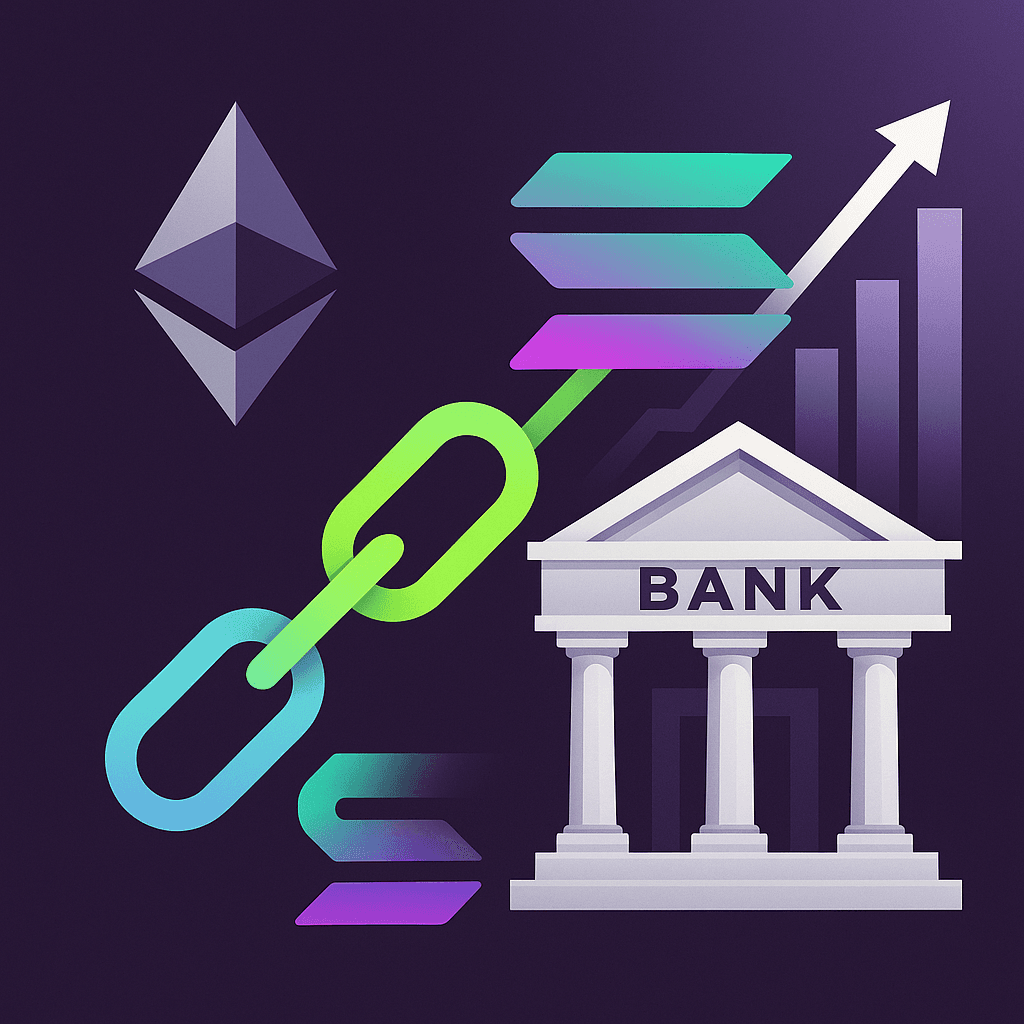
The Multi-Chain Mirage: Why Going Deep Beats Going Wide
When building DeFi business banking infrastructure, most crypto companies hedge their bets across multiple blockchains. Ethereum, Polygon, Avalanche - they deploy everywhere, thinking diversification reduces risk.
At RebelFi, we made the opposite bet: all-in on Solana. No Ethereum layer-2s. No "safety" deployments on Base. Just one blockchain, optimized for crypto treasury management and instant yield DeFi.
After 18 months building the first crypto point of sale system and programmable yield infrastructure, we're more convinced than ever: focus beats fragmentation.
Here's why Solana DeFi yield infrastructure is crushing multi-chain competitors in 2025.
Solana vs Ethereum: The Performance Numbers That Matter
Speed: Why Transaction Throughput Determines Everything
Solana's current performance:
1,279 TPS average daily throughput
2,909 TPS maximum recorded
0.4 seconds block time
12.8 seconds finality
Ethereum's limitations:
15-30 TPS on mainnet
12-15 seconds block time
$0.30 average transaction fees
For high yield business bank accounts processing hundreds of transactions daily, this isn't just about speed, it's about unit economics. Solana TPS is 1,279 transactions per second while Ethereum can handle fewer than 15 TPS, while average transaction fees are around $0.30.
Cost Structure: Why Fees Matter for Crypto Cash Management
Solana is made to handle thousands of transactions per second, and fees for both developers and users remain less than $0.0025. More specifically, Solana has some of the lowest network fees on the market, typically around just a fraction of a cent (A$0.00038 per transaction).
When you're building a zero fee payment processor crypto business model, every fraction of a cent matters. Our entire payment flow - token swap, yield deployment, settlement—costs less than running a Google search.
Multi-Chain Development: The Hidden Complexity Tax
Why 84% of DApps Choose Single-Chain Architecture
According to the most recent analysis from Tatum, an overwhelming majority, 84% of applications have been developed on a single blockchain, while only mere 16% have made multi-chain architecture the choice for their applications.
The reason? Multi-chain isn't just multiple deployments, it's multiple products.
Each blockchain requires:
Different smart contract architectures (EVM vs Solana's account model)
Unique security audits and testing
Chain-specific developer expertise
Separate maintenance and updates
Individual compliance frameworks
The effort to build, maintain, and update a multi-chain application is immense, especially because new blockchains are constantly emerging. For each new blockchain, developers must change their code to fit the blockchain's specific technical requirements, ensure the code is well-written and secure, and maintain each instance separately.
The Bridge Security Problem
While building across multiple chains, you're exposed to bridge vulnerabilities. Historically, cross-chain bridges and messaging protocols have suffered from poor security, resulting in $2.5B+ in total value being hacked from bridges in 2022.
For DeFi treasury tools handling business capital, bridge risk isn't theoretical, it's existential.
Solana Smart Contracts: Built for Financial Applications
Account Model Advantages for Crypto Treasury Management
Unlike Ethereum, which is designed to run on consumer grade hardware, Solana was designed to optimize transaction throughput on high-end multi-core machines.
This architectural choice enables programmable yield features impossible on other chains:
Smart Account Capabilities:
Yield splitting between principal and returns
Pull-based crypto payments where recipients claim funds when convenient
Multi-signature treasury operations for business governance
Automated recurring payments without user interaction
Composability: Why Single-Chain Wins for DeFi
True stablecoin yield infrastructure requires atomic transactions across multiple protocols. On Solana, our payment system can:
Accept any Solana token (including meme coins)
Swap via Jupiter aggregation
Deploy to Drift Protocol for yield
Return profits to merchant accounts
All in one transaction. No bridge delays, no multi-chain coordination failures, no mysterious "pending" states affecting crypto account with recurring payments.
Solana's 2025 Performance Breakthrough
Revenue and Adoption Metrics
Solana also reported over $1 billion in Q2 2025 revenue, fueled by growing user engagement, dApp volume, and DeFi activity. Despite maintaining some of the lowest fees in the industry (averaging just $0.00025 per transaction), the sheer scale of usage translated into significant revenue.
Earlier, Solana achieved a new all-time high: 1,504 transactions per second (TPS). While this is only a fraction of the network's theoretical max of 65,000 TPS, it marks the highest real-world throughput recorded on any blockchain to date.
Developer Ecosystem Growth
In 2025, Solana reemerged as a magnet for developers looking for speed and scalability in the competitive world of blockchain development.
Why developers choose Solana for DeFi:
Rust programming language for memory safety
Strong financial incentives through grants and accelerators
Enterprise adoption creating real-world demand
Advanced tooling with Anchor framework
Solana vs Ethereum vs Polygon: Performance Analysis for Business DeFi
When evaluating stablecoin yield infrastructure options, the performance differences are striking:
Solana's advantages:
1,279 average TPS with 0.4-second block times for instant settlements
$0.00025 transaction costs enabling profitable micro-transactions
Native programmability through Rust-based smart contracts
127% DeFi TVL growth in 2024, outpacing all competitors
Ethereum's limitations:
15-30 TPS maximum creating bottlenecks during high demand
$0.30+ transaction fees that eliminate small payment profitability
12-15 second block times causing user experience friction
Limited account model requiring complex workarounds for advanced features
Polygon's middle ground:
190 TPS better than Ethereum but still 6x slower than Solana
$0.01-0.05 fees reduced but still 40x higher than Solana
EVM compatibility but inherits Ethereum's architectural limitations
23% TVL growth showing slower ecosystem adoption
Why RebelFi Chose Solana for Crypto Mobile Payments
Instant Yield Requirements
Building yield generating smart accounts requires atomic deployment of funds. When a coffee shop accepts payment through our crypto point of sale system, those funds must immediately start earning in USDC yield accounts.
The RebelFi Flow:
Customer pays with any token
Same-transaction swap to USDC
Instant deployment to Drift Protocol
Immediate yield accrual for merchant
This instant yield DeFi experience is only possible on Solana's architecture.
Enterprise-Grade Security for Stablecoin Business Accounts
Programming in Rust, the most commonly used language for smart contracts, requires deep technical knowledge, which enhances protection against potential attacks.
Our non-custodial yield accounts leverage Solana's security model for:
Treasury-grade asset protection
Programmable authorization controls
Audit-friendly on-chain transparency
Compliance-ready transaction logging
The Network Effects Advantage
Why Solana's DeFi Ecosystem Is Winning
According to a recent research report by crypto data aggregator CoinGecko, Solana leads with the highest daily average transactions per second (TPS), clocking in at 1,053 TPS.
Solana DeFi Infrastructure:
Jupiter: Best-in-class DEX aggregation
Drift Protocol: Institutional-grade lending
Lulo: Automated yield optimization
Phantom/Solflare: 15M+ wallet users
This ecosystem depth creates programmable money APIs and stablecoin banking rails that multi-chain approaches can't match.
Integration Benefits for Crypto Developer Banking Tools
By focusing on Solana, we can build deeper integrations:
Native wallet connections for seamless UX
Protocol-level partnerships for better yields
Ecosystem grants and technical support
Shared liquidity across all Solana applications
FAQ: Solana DeFi for Business Banking
What makes Solana better than Ethereum for crypto treasury management?
Solana processes 1,279 transactions per second compared to Ethereum's 15 to 30 TPS, providing the throughput necessary for real-time business payment operations. Transaction costs on Solana average $0.00025 versus Ethereum's $0.30 or higher, which creates dramatically better unit economics for companies processing thousands of daily transactions. Solana's programmable account model allows fund receipt, currency conversion, and yield deployment to execute in a single atomic transaction, meaning businesses start earning returns the moment payment arrives rather than waiting through multiple confirmation blocks. For a company processing $1 million monthly in stablecoin payments, Solana's fee structure saves roughly $3,500 compared to Ethereum while settling 40 times faster. The network's sub-second finality eliminates the 12 to 15 second block confirmation delays that make Ethereum impractical for point-of-sale applications. Combined with native USDC integration through Circle's cross-chain transfer protocol, Solana delivers institutional-grade treasury management infrastructure at a fraction of competing network costs.
How does Solana's instant yield work for business accounts?
Solana's atomic transaction architecture bundles multiple financial operations into a single blockchain instruction that either completes entirely or reverts completely. When a business receives a $25,000 payment, the atomic transaction simultaneously confirms receipt, converts any non-USDC tokens at the best available rate across 8 or more liquidity sources through Jupiter aggregation, and deposits the resulting stablecoins into yield-generating protocols like Drift. This entire sequence executes in under 400 milliseconds and costs less than $0.001 in network fees. On Ethereum, the same workflow requires 3 separate transactions across different blocks, costing $1 to $5 in gas fees and taking 36 to 45 seconds minimum. The practical result is that yield begins accruing within half a second of payment receipt on Solana versus minutes or hours on competing chains. For businesses processing 200 or more transactions daily, this difference compounds into thousands of additional dollars in annual yield captured during settlement windows that other networks waste on confirmation delays.
Is single-chain development risky compared to multi-chain?
Single-chain development concentrates engineering resources on one well-understood platform rather than spreading them across 4 or 5 different blockchains with incompatible architectures. Research from Electric Capital shows that 84% of blockchain applications have been built on a single chain, because mastering one ecosystem produces more reliable software than maintaining shallow integrations across many. Multi-chain strategies introduce bridge vulnerabilities that have caused over $2.5 billion in losses since 2021, including major exploits targeting cross-chain communication protocols. Building exclusively on Solana eliminates these bridge risks entirely while enabling deeper integration with the network's unique features like programmable accounts and parallel transaction processing. Development teams ship features 3 to 4 times faster when working within one SDK and testing framework rather than juggling multiple toolchains. Security audits cost roughly 60% less for single-chain deployments because auditors review one codebase instead of multiple implementations with different attack surfaces. The depth-over-breadth approach lets businesses offer more sophisticated treasury features rather than basic functionality replicated across chains.
What are the best Solana DeFi protocols for business banking?
The strongest Solana DeFi protocols for business banking include Drift Protocol for lending and perpetual markets, Jupiter for token swaps and aggregated liquidity routing, and MarginFi for structured lending positions. Drift currently manages over $800 million in total value locked and offers USDC lending yields between 6% and 8% APY through its institutional-grade lending markets. Jupiter aggregates liquidity from more than 12 decentralized exchanges to guarantee optimal swap rates, processing over $500 million in daily volume. Circle's native USDC integration on Solana enables zero-slippage deposits and withdrawals without bridge fees. Marinade Finance provides liquid staking options for SOL reserves that businesses may hold for network fee payments. For automated treasury management, these protocols connect through Solana's composable program architecture, allowing a single transaction to interact with 3 or more protocols simultaneously. RebelFi's platform integrates directly with these protocols to provide a unified dashboard for crypto cash management, eliminating the need for businesses to manage multiple protocol interfaces independently.
How do Solana transaction fees compare to traditional payment processors?
Solana network fees average $0.00025 per transaction, making them effectively invisible for business payment processing. To put this in perspective, a business processing 10,000 monthly transactions pays roughly $2.50 in total Solana fees compared to $30,000 at a typical 3% credit card processing rate on the same $1 million volume. Even accounting for priority fees during peak network usage, Solana transaction costs rarely exceed $0.01, which is still 300 times cheaper than the lowest credit card interchange rates. Wire transfer fees at major banks range from $25 to $50 per domestic transaction and $40 to $75 for international transfers, meaning a single wire costs more than 100,000 Solana transactions. For businesses processing $100,000 monthly, the switch from traditional payment rails to Solana-based stablecoin payments saves between $1,500 and $3,500 in direct processing fees every month. These savings compound further when factoring in the 6% to 8% yield earned on payment float during settlement windows, turning the payment function from a pure cost center into a revenue-generating operation.
Can businesses earn yield on USDC using Solana?
Businesses earn yield on USDC through Solana DeFi protocols by depositing stablecoins into lending markets where verified borrowers pay interest for access to liquidity. Drift Protocol currently offers 6% to 8% APY on USDC deposits, with rates adjusting dynamically based on borrowing demand across its markets. The process requires no lockup periods, meaning businesses can withdraw their full balance plus accrued interest at any time without penalties. MarginFi provides similar yields through its isolated lending pools, where each market carries independent risk parameters. A company depositing $500,000 in USDC across these 2 protocols generates roughly $30,000 to $40,000 in annual yield while maintaining instant liquidity for operational needs. All deposits remain non-custodial, controlled entirely by the business's own wallet keys rather than a third-party custodian. Smart contract automation handles rebalancing between protocols every 4 to 6 hours to capture the best available rates. The entire yield history is verifiable on-chain, providing complete transparency for accounting and audit purposes that traditional bank interest statements cannot match.
The Future of DeFi Business Banking
Enterprise Adoption Trends
Enterprise traction boosts network confidence and creates a positive feedback loop. As more companies adopt Solana, custom d-apps are needed, giving developers greater opportunity to create real-world solutions.
Growing enterprise use cases:
Corporate treasury management with programmable controls
Cross-border payroll with instant settlement
Supply chain financing with automated escrows
Subscription billing with yield optimization
Regulatory Clarity Driving Adoption
With stablecoin adoption 2025 accelerating and regulatory frameworks like the GENIUS Act providing clarity, businesses are increasingly comfortable with USDC for cross border payments and stablecoin vs traditional bank accounts for business.
Conclusion: Why Focus Beats Fragmentation
Choosing Solana wasn't just a technical decision it was a strategic one. By going deep instead of wide, we've built DeFi infrastructure for banks and white label stablecoin infrastructure that delivers experiences impossible on other chains.
The results:
Zero-fee payment processing through yield capture
Instant settlement into productive assets
Enterprise-grade security with consumer simplicity
Programmable treasury management tools
While competitors fragment across multiple chains, we're doubling down on the fastest growing blockchain ecosystem with the strongest fundamentals for financial applications.
Ready to experience Solana-native business banking? Explore high-yield business accounts built for the blockchain era.