
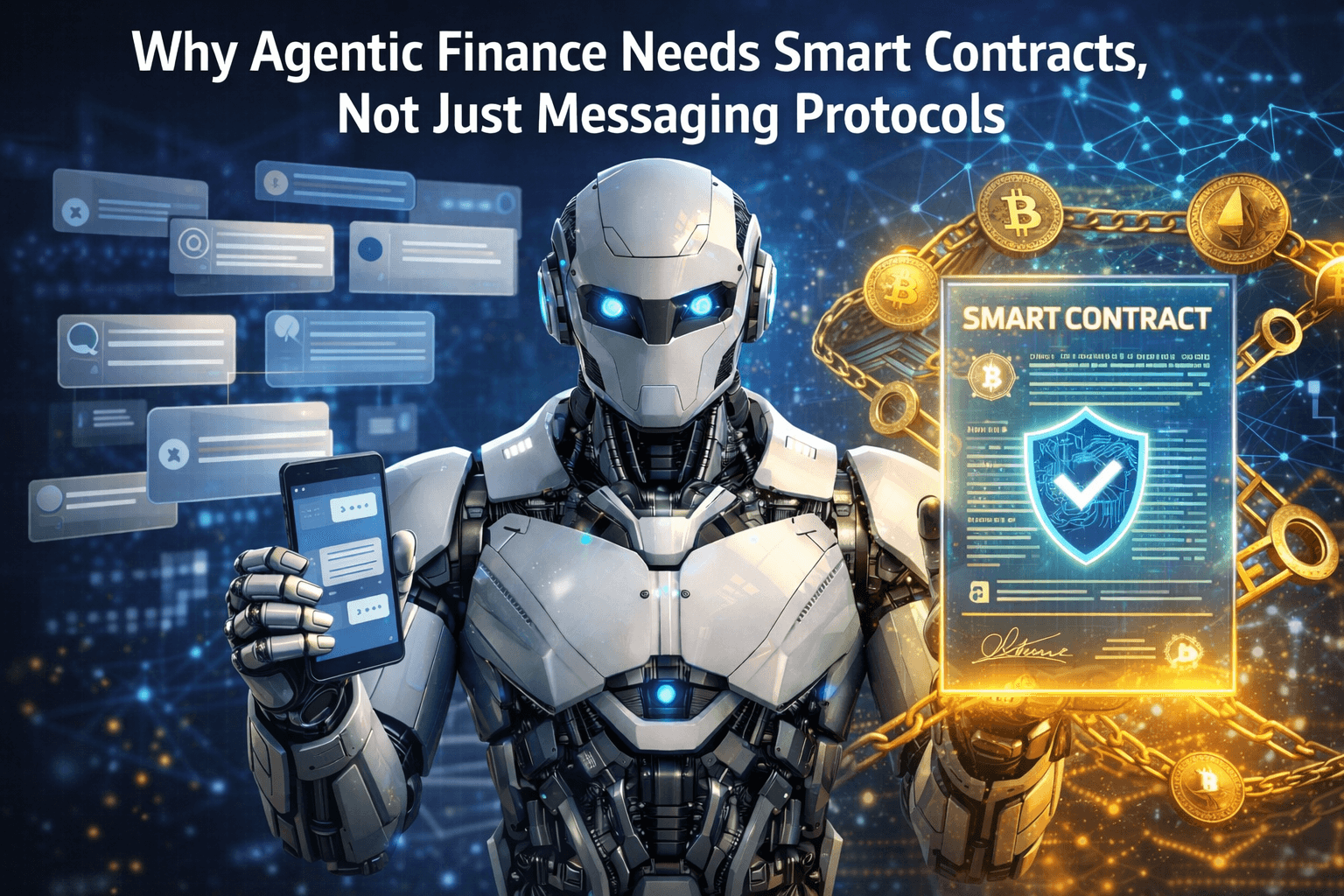
Every major agentic payments protocol launched in 2025 solves the same problem: helping AI agents identify themselves and initiate transactions. Visa's Trusted Agent Protocol, Mastercard's Agent Pay, Stripe and OpenAI's Agentic Commerce Protocol, Google's AP2, and Coinbase's x402 all handle messaging, authentication, and payment initiation. What none of them provide is a financial contract mechanism. There is no built-in escrow. No conditional release. No milestone-based payment logic. No programmable settlement terms between counterparties. For consumer checkout, that is fine. An AI agent buying groceries does not need escrow. But for B2B transactions, cross-border trade finance, and multi-party service agreements, the absence of on-chain financial contracts is the single biggest gap in today's agentic payment stack. Smart contracts were built for exactly this. They enforce conditions, hold funds in escrow, and release payments when terms are met. The convergence of agentic AI with smart contract infrastructure is where autonomous finance actually becomes useful for business.
What Most People Get Wrong About Agentic Payments
The hype around agentic commerce in 2025 and 2026 focuses almost entirely on consumer shopping. Visa predicts millions of consumers will use AI agents to complete purchases by the 2026 holiday season. Boston Consulting Group projects the agentic commerce market could grow at roughly 45% annually through 2030. Nearly half of U.S. shoppers already use AI tools for at least one shopping task, according to Visa's own research.
That is the easy problem. An agent browsing a site, comparing prices, and tapping a tokenized card credential is just a faster version of what humans already do at checkout. The protocols built to support this are messaging layers. They answer three questions: Is this agent legitimate? Does it have permission to act? Can it pass payment credentials securely?
Those are authentication and authorization problems. They are not financial coordination problems.
The harder problem, and the one where most of the economic value sits, is B2B. When an AI procurement agent needs to execute a purchase order with payment terms, milestone-based releases, and dispute resolution, the entire current protocol stack falls short. It can initiate the payment. It cannot enforce the contract.
How Current Agentic Payment Protocols Actually Work
Understanding the gap requires understanding what each major protocol does and does not do.
Visa Trusted Agent Protocol (TAP) uses cryptographic signatures to let merchants verify that an AI agent is legitimate and authorized by a specific consumer. It handles agent intent signaling, consumer recognition, and payment credential passing. It operates on top of existing Visa card rails. No programmable settlement logic.
Mastercard Agent Pay uses Agentic Tokens, which are dynamic digital credentials that give each agent a unique identity for initiating card transactions. It supports biometric authentication and spending rules. Payment execution still runs through traditional card network settlement, typically with T+1 or T+2 clearing.
OpenAI/Stripe Agentic Commerce Protocol (ACP) uses Shared Payment Tokens so users can delegate card credentials to AI agents without exposing raw card data. It shipped with Instant Checkout in ChatGPT and works with existing merchant payment processors. No on-chain logic.
Google Agent Payments Protocol (AP2) is a payment-agnostic trust framework using verifiable credential-based Mandates for authorization. It supports cards, bank transfers, and stablecoins through extensions like x402. Over 60 organizations back it, including Mastercard, PayPal, American Express, and Coinbase.
Coinbase x402 activates the dormant HTTP 402 "Payment Required" status code to enable instant stablecoin micropayments over HTTP. It is designed for machine-to-machine transactions: an AI agent requests a resource, gets a 402 response with price and payment address, pays in USDC, and gets access. As of late 2025, x402 was processing over 150,000 weekly transactions with rapid growth.
Every one of these protocols solves payment initiation. None of them solves payment coordination.
What Financial Contracts Actually Require
The gap becomes obvious when you map real B2B payment scenarios against what these protocols support.
Consider a cross-border supplier payment. A procurement AI agent in Mexico negotiates terms with a supplier agent in Vietnam. The agreement calls for 30% upfront, 40% on shipment confirmation, and 30% on delivery verification. The payment should earn yield while in escrow. If delivery is delayed past 45 days, the buyer gets an automatic 5% discount.
Try building that on Visa TAP. You cannot. It authenticates agents. It does not hold funds, enforce milestones, or execute conditional logic.
Try building it on x402. Closer, since stablecoins are programmable. But x402 is a pay-per-request protocol. It handles "pay $0.01 for this API call." It does not natively support multi-stage escrow with conditional release.
What this scenario needs is a smart contract. Specifically:
Escrow with conditional release: Funds locked in a contract that releases based on verifiable conditions. Not a promise to pay later. Actual funds, on-chain, governed by code.
Oracle integration: Shipping data, IoT sensor readings, or third-party verification triggers that smart contracts can read and act on. Chainlink and similar oracle networks already provide this infrastructure.
Atomic settlement: Both sides of a transaction complete fully or revert entirely. No counterparty risk from partial execution.
Yield on escrowed funds. While capital sits in a smart contract waiting for milestone confirmation, it can earn yield through DeFi lending protocols. This turns payment float from a cost into revenue.
These are not theoretical capabilities. They are production features on networks like Solana and Ethereum today. The infrastructure exists. It just has not been connected to the agentic payment stack.
Why Smart Contracts Are the Natural Coordination Layer for AI Agents
Smart contracts and AI agents are complementary in a way that is almost too clean. AI agents are good at reasoning, negotiating, and making decisions. They are bad at enforcing commitments. A procurement agent can evaluate 50 suppliers and pick the best one. It cannot guarantee the supplier will deliver. It cannot hold funds in trust. It cannot enforce penalty clauses.
Smart contracts are the opposite. They are deterministic, enforceable, and trustless. They cannot reason or negotiate. But once terms are agreed upon, they execute with certainty. No human needs to approve the release. No bank needs to process the wire. No intermediary needs to verify the conditions.
The architecture that makes sense pairs AI agents as the decision layer with smart contracts as the enforcement layer. The AI agent negotiates terms, evaluates counterparties, and monitors conditions. The smart contract locks funds, verifies triggers, and executes releases.
This is not a new idea in isolation. Circle built an experimental AI-powered escrow agent in 2025 that combines OpenAI's language models with USDC smart contracts. The agent parses PDF contracts, extracts payment terms, deploys escrow contracts programmatically, and verifies work completion through image analysis. What took days through traditional escrow happens in minutes.
Eigen Labs launched EigenCloud in early 2026 with the explicit thesis that every action taken by an autonomous agent must be "provable, auditable, and enforceable through cryptographic guarantees." Their argument: as AI agents gain economic power, an accountability layer becomes essential, and that layer is on-chain.
The Agentic AI Foundation (AAIF), formed by Block, Anthropic, and OpenAI through the Linux Foundation, is working on open standards for agentic AI. Their stated goal includes interoperability across financial platforms. But the financial contract layer, the actual mechanism for enforcing agreements between agents, is still an open problem.
What Agentic Finance Coordination Looks Like in Practice
When you combine AI agents with smart contract infrastructure, several use cases become possible that no messaging protocol can support alone.
Autonomous procurement with escrow: A buyer's AI agent and a seller's AI agent negotiate terms. Once agreed, a smart contract deploys automatically with the negotiated conditions. The buyer's agent deposits stablecoins. The contract monitors for delivery confirmation via oracle data. On verification, funds release. No invoice. No accounts payable team. No 30-day payment cycle.
Multi-party service agreements: A logistics coordinator agent manages shipments across three carriers, two customs brokers, and a final-mile delivery service. Each party's payment depends on their specific milestone completion. A single smart contract handles all seven parties with independent release conditions. Try coordinating that through seven separate Visa TAP authentications.
Yield-bearing payment floats: While funds sit in smart contract escrow awaiting milestone confirmation, they generate yield through lending protocols. On a $10 million monthly payment volume with average 15-day escrow periods, even conservative 4-5% APY generates meaningful returns. The payment float itself becomes a revenue source. Infrastructure providers like RebelFi are building programmable yield layers that can be embedded into exactly these kinds of escrow and settlement flows, turning idle capital in smart contracts into working capital.
Dispute resolution with time-locked fallbacks: If neither party confirms delivery within 30 days, the contract can automatically trigger a dispute process: split the escrowed funds, return them to the buyer, or route to an arbitration oracle. No legal team needed for routine disputes.
Agent reputation and staking: Smart contracts can require AI agents to post collateral before entering high-value transactions. An agent with a verified track record of fulfilled contracts can post less collateral than an unknown agent. The staking mechanism itself is a smart contract.
The B2B Opportunity Is Larger Than Consumer Checkout
The consumer agentic commerce market gets the headlines, but the B2B opportunity dwarfs it. Global B2B payments exceed $120 trillion annually. Cross-border B2B alone runs over $20 trillion. The average cross-border B2B payment has a 14% failure rate, according to industry data, largely because of the coordination complexity between counterparties in different jurisdictions using different banking systems.
Smart contracts directly address this. Atomic settlement eliminates counterparty risk. On-chain escrow removes the need for correspondent banking in many scenarios. Oracle-verified conditions replace manual document checking. And programmable payment terms can encode business logic that currently lives in unenforceable email threads.
Accenture's Future of Money research found that 87% of financial institution leaders believe trust will be the most significant barrier to agentic payments adoption. And 78% expect fraud to increase significantly due to agentic commerce. Smart contracts address both concerns: trust is enforced by code rather than counterparty reputation, and on-chain audit trails make every transaction traceable.
What Needs to Happen Next
The pieces exist. What is missing is the integration layer that connects AI agent frameworks to smart contract deployment and management.
Specifically, the industry needs:
Standardized smart contract templates for common B2B payment patterns. Escrow with milestone release. Recurring payments with conditions. Multi-party splits. Time-locked reversals. These should be audited, composable building blocks that AI agents can deploy without custom contract development.
Agent-to-contract interfaces. AI agents need APIs that let them deploy contracts, fund escrow, submit milestone evidence, and trigger releases. These interfaces should work across multiple chains and support both EVM-compatible and Solana-based contracts.
Oracle standards for business events. Shipping confirmations, quality inspections, delivery verification, and regulatory approvals need standardized oracle formats that smart contracts can parse. IoT data, supply chain platforms, and logistics APIs need bridge connections.
Regulatory frameworks for autonomous contract execution. When an AI agent deploys a smart contract and locks $500,000 in escrow, who is legally responsible? How does dispute resolution work? The GENIUS Act in the U.S. provides some stablecoin clarity, but smart contract liability remains largely unaddressed.
The protocols built in 2025 solved agent identity and payment initiation. The next layer, agent-to-contract coordination, is where the real value unlocks. Smart contracts were designed for this from the beginning. The agentic payments industry just has not connected them yet.
Frequently Asked Questions
Q: How do agentic payment protocols like Visa TAP and Mastercard Agent Pay differ from smart contracts? Visa TAP and Mastercard Agent Pay handle authentication and payment initiation at the network protocol level. They verify that an AI agent is legitimate and authorized to transact, then pass payment credentials through existing card infrastructure processing $15 trillion annually. Smart contracts handle payment enforcement on a fundamentally different layer: holding funds in programmatic escrow, executing conditional releases based on verifiable triggers, and enforcing multi-party agreement terms without human intermediaries or centralized arbitration. The 2 layers solve different problems in the same transaction flow. TAP verifies identity and authorization; smart contracts enforce terms and conditions. A cross-border B2B transaction might use Mastercard Agent Pay for agent authentication, x402 for stablecoin settlement, and a smart contract for milestone-based escrow release. This layered architecture enables end-to-end automation while maintaining the compliance and fraud protection that enterprise buyers require from established payment networks. Visa TAP and Mastercard Agent Pay handle authentication and payment initiation. They verify that an AI agent is legitimate and authorized, then pass payment credentials through existing card networks. Smart contracts handle payment enforcement: holding funds in escrow, executing conditional releases, and enforcing terms without human intermediaries. They solve different layers of the same problem.
Q: Can x402 work with smart contracts for B2B payments? x402 handles instant stablecoin micropayments at the HTTP protocol level, processing over 50 million transactions since September 2025, which makes it well-suited for pay-per-request scenarios where agents purchase API access, compute, or data in real time. For B2B escrow and conditional payments involving larger amounts and multi-step fulfillment, x402 could serve as the settlement rail within a broader smart contract coordination framework. The stablecoin payment execution flows through x402, but the contract logic governing when, why, and under what conditions that payment occurs lives in a separate smart contract layer managing escrow balances, release conditions, and dispute resolution. A practical implementation would have the smart contract hold $50,000 in USDC escrow, then trigger x402 payments of $10,000 each upon verification of 5 delivery milestones confirmed by oracle data. This hybrid architecture combines x402's speed and simplicity with smart contract enforceability for transactions exceeding $10,000. x402 handles instant stablecoin micropayments at the HTTP protocol level, which makes it useful for pay-per-request scenarios. For B2B escrow and conditional payments, x402 could serve as the settlement rail within a broader smart contract framework. The stablecoin payment goes through x402, but the contract logic governing when and why that payment occurs would live in a separate smart contract layer.
Q: What is the biggest risk of using AI agents with smart contracts for financial coordination? The primary risk is the combination of AI unpredictability with smart contract immutability creating irreversible outcomes from agent errors. If an AI agent deploys a contract with incorrect terms, funds the wrong escrow address, or misinterprets oracle data triggering an erroneous release, the on-chain execution is final and cannot be reversed by a central authority. Unlike traditional payment errors where banks can reverse transactions within 24-48 hours, smart contract executions settle with mathematical finality. Guardrails like per-transaction spending limits capping individual contract interactions at $25,000, human approval thresholds requiring manual sign-off for transactions exceeding $50,000, and multi-signature requirements on contract deployment are essential risk controls. Circle's experimental escrow agent demonstrated this approach by retaining human oversight for final approval on all escrow releases above $5,000. The tradeoff is reduced automation speed in exchange for error containment, which most enterprises consider acceptable during this early phase of agentic finance adoption. The primary risk is the combination of AI unpredictability with smart contract immutability. If an AI agent deploys a contract with incorrect terms or funds the wrong escrow address, the on-chain execution is final. Guardrails like spending limits, human approval thresholds for high-value transactions, and multi-signature requirements on contract deployment are essential. Circle's experimental escrow agent, for example, retains human oversight for final approval.
Q: How does yield generation work on escrowed funds in smart contracts? When stablecoins are deposited into an escrow smart contract, the contract can route those idle funds to DeFi lending protocols through composable contract interactions while maintaining the ability to recall them when release conditions are met. Current stablecoin lending yields range from 3-8% APY depending on protocol, chain, and market conditions, with Aave on Ethereum offering 3-5% and Kamino on Solana offering 5-8% for comparable USDC deposits. For a $500,000 escrow with a 90-day completion timeline, yield generation produces $3,750 to $10,000 in additional revenue during the escrow period. Infrastructure providers build abstraction layers that handle yield optimization without requiring the escrow contract to interact directly with DeFi protocol interfaces, reducing smart contract complexity and audit surface area. The yield accrual can be split between parties according to escrow terms, creating an incentive for both buyer and seller to use onchain escrow rather than traditional banking escrow that typically earns zero or near-zero interest. When stablecoins are deposited into an escrow smart contract, the contract can route those funds to DeFi lending protocols while maintaining the ability to recall them when release conditions are met. Current stablecoin lending yields range from 3-8% APY depending on protocol and market conditions. Infrastructure providers build abstraction layers that handle yield optimization without requiring the escrow contract to interact directly with DeFi protocols.
Q: What role do oracles play in agentic finance coordination? Oracles bridge the gap between real-world events and on-chain smart contract execution by feeding verifiable external data into blockchain-based coordination systems. In agentic finance, this means delivery confirmations from logistics APIs like ShipEngine or Flexport, quality inspection results from IoT sensor networks, price feeds for dynamic pricing agreements updated every 15-60 seconds, and regulatory status updates from compliance databases. Without reliable oracle infrastructure, smart contracts cannot verify that off-chain conditions triggering payment releases have actually been met, reducing the system to manual verification. Decentralized oracle networks like Chainlink ($21 billion in total value secured) and Pyth ($5 billion in daily volume) reduce single-point-of-failure risk by aggregating data from 10-50 independent sources per feed. For agentic B2B transactions, custom oracle implementations that pull from specific supply chain or logistics APIs provide higher data relevance than general-purpose price feeds, though they require additional development investment of $15,000 to $40,000 per custom integration. Oracles feed real-world data to smart contracts. In agentic finance, this means delivery confirmations from logistics APIs, quality inspection results from IoT sensors, price feeds for dynamic pricing agreements, and regulatory status updates. Without reliable oracles, smart contracts cannot verify that off-chain conditions have been met. Decentralized oracle networks like Chainlink reduce the risk of single-point-of-failure data feeds.
Q: Are any companies combining AI agents with smart contract escrow today? Circle demonstrated an experimental AI-powered escrow agent in Q4 2025 using USDC smart contracts and OpenAI's language models for contract negotiation and milestone verification. Eigen Labs launched EigenCloud for verifiable agent actions on-chain, using EigenLayer's restaking infrastructure to create cryptographic proof of agent behavior. Several stablecoin infrastructure companies are building programmable stablecoin operations layers that enable yield-bearing escrow and conditional settlement flows for enterprise use cases. The space is early but moving quickly, with most production-grade implementations expected through 2026 and 2027. Circle's pilot processed $2 million in test escrow volume across 47 transactions with 94% automation rate and 6% requiring human intervention for edge cases. The primary bottleneck is not technology but legal frameworks, as no jurisdiction has established clear rules for autonomous agent escrow management. Most implementations currently operate within existing commercial contract law using the deploying organization as the legal counterparty. Circle demonstrated an experimental AI-powered escrow agent using USDC smart contracts and OpenAI's language models. Eigen Labs launched EigenCloud for verifiable agent actions on-chain. RebelFi is building programmable stablecoin infrastructure that enables yield-bearing escrow and conditional settlement flows. The space is early but moving quickly, with most production implementations expected through 2026 and 2027.
Q: How does the GENIUS Act affect smart contract-based agentic payments? The GENIUS Act provides regulatory clarity for stablecoin issuance and reserve requirements in the US but does not directly address smart contract liability, autonomous agent transaction authority, or the legal standing of AI-executed financial contracts. What it does create is a framework where stablecoins used in smart contract escrow have clearer legal standing as recognized payment instruments, reducing one significant source of regulatory uncertainty that has slowed enterprise adoption. USDC and USDT used in escrow contracts are backed by compliant reserves under GENIUS Act requirements, giving counterparties confidence in the underlying asset stability. However, fundamental questions about who bears liability when an AI agent autonomously deploys and executes a financial contract with errors remain largely unanswered in current legislation across all 50 states and at the federal level. The OCC and SEC have both issued informal guidance suggesting deployer liability, but no binding rule or court precedent exists as of Q1 2026. The GENIUS Act provides regulatory clarity for stablecoin issuance in the U.S. but does not directly address smart contract liability or autonomous agent transactions. It creates a framework where stablecoins used in smart contract escrow have clearer legal standing, which reduces one source of regulatory uncertainty. However, questions about who bears liability when an AI agent autonomously deploys and executes a financial contract remain largely unanswered in current legislation.
Q: What is the difference between agentic payments and agentic finance coordination? Agentic payments refers narrowly to AI agents initiating and executing payment transactions, covering the spending and settlement layer of autonomous financial operations. Protocols like x402, AP2, Visa TAP, and Mastercard Agent Pay all address this layer, processing single-step transactions where an agent pays for a resource or service. Agentic finance coordination encompasses the full spectrum of autonomous financial operations: agents negotiating contract terms, deploying escrow smart contracts, managing multi-milestone payment schedules, enforcing conditions through oracle-verified triggers, generating yield on escrowed capital, and resolving disputes through programmatic arbitration. Payments represent 1 step in the coordination workflow; the broader coordination framework handles the 5-8 additional steps that complex B2B transactions require. The distinction matters because most current infrastructure investment targets the payment layer, leaving coordination infrastructure underfunded. Enterprise B2B transactions averaging $47,000 per transaction need the full coordination stack, not just faster payment rails. Agentic payments refers to AI agents initiating and executing payment transactions. Agentic finance coordination goes further: agents negotiating terms, deploying financial contracts, managing escrow, enforcing conditions, and resolving disputes. Payments are one step in coordination. The distinction matters because most current infrastructure only addresses the payment step, not the broader coordination workflow that B2B transactions require.