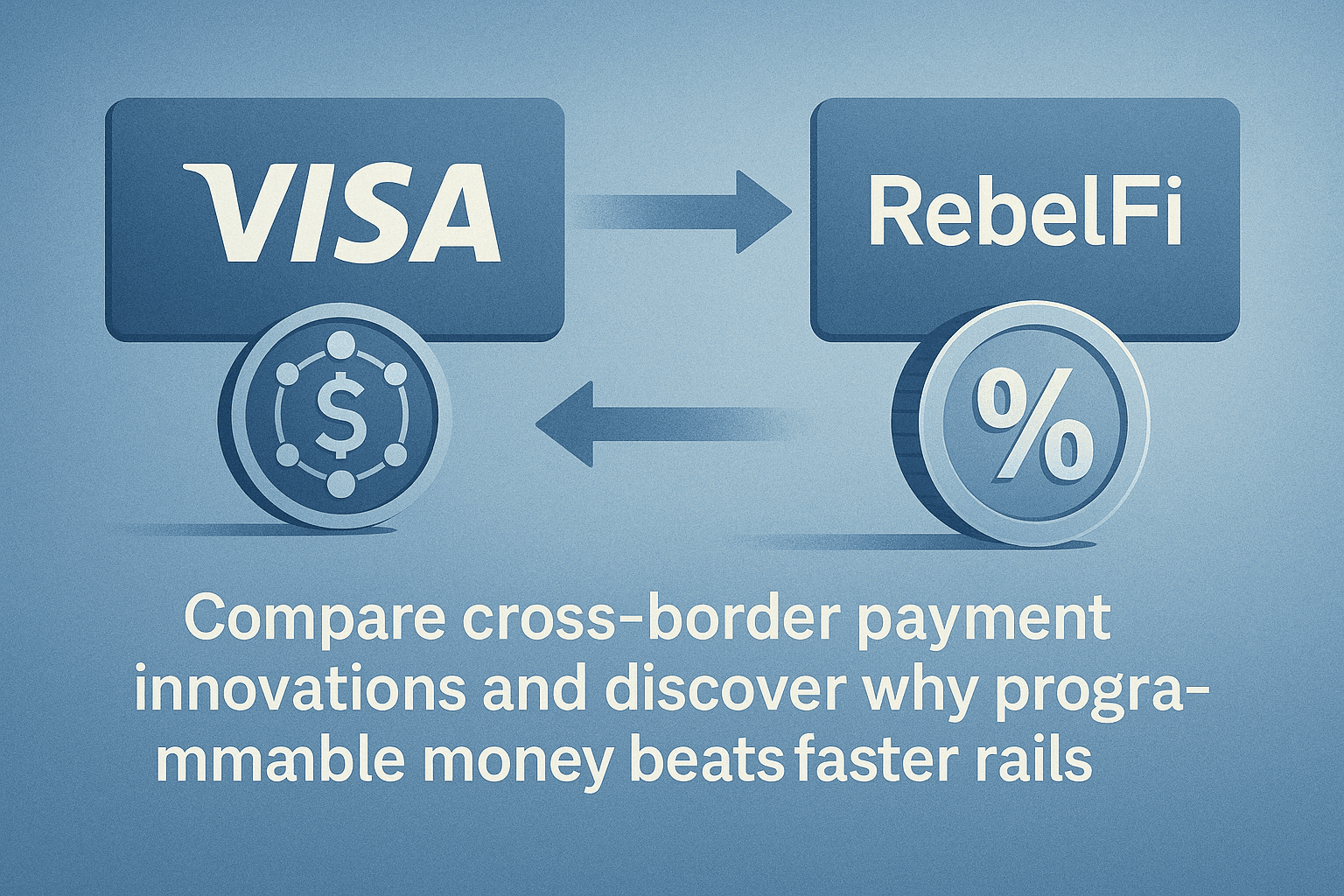
In September 2025, Visa announced a stablecoin prefunding pilot promising to revolutionize cross-border payments through speed. But while Visa optimizes for faster movement, they're missing the bigger opportunity: making money productive.
RebelFi transforms idle stablecoin capital into yield-generating assets earning 6-9% APY while maintaining instant liquidity. The result? Payments that generate revenue instead of costing fees.
Visa's Stablecoin Strategy: Speed Without Yield
Visa's stablecoin prefunding pilot through Visa Direct lets businesses fund cross-border payments with stablecoins instead of fiat. Announced at SIBOS 2025, the initiative targets banks, remittance providers, and enterprises with high-volume international payment needs.
Key Benefits of Visa's Approach:
Faster Settlement: Minutes instead of days for international transfers
Liquidity Optimization: No need to park large fiat balances in advance
Reduced Costs: Lower fees versus traditional correspondent banking
Treasury Modernization: Dynamic capital management across borders
The pilot launches in limited availability April 2026, supporting multiple stablecoins including USDC, PYUSD, and USDG across Ethereum, Solana, Stellar, and Avalanche blockchains.
The Critical Gap: Visa's infrastructure generates zero yield on stablecoin balances.
The Billion-Dollar Opportunity Cost
For a fintech processing $10 million daily in cross-border payments, zero-yield infrastructure means leaving $600,000-$900,000 annually on the table.
The Math:
Visa Model: $10M capital × 0% yield = $0 earned
Yield Infrastructure: $10M capital × 7% APY = $700,000 earned
Current stablecoin yields in 2025:
CeFi Platforms: 6-14% APY (Binance, Nexo)
DeFi Protocols: 5-12% APY (Aave, Drift, Compound)
Tokenized Treasuries: 4-5% APY (Ondo USDY, BlackRock BUIDL)
The yield-bearing stablecoin market has exploded from $1.5 billion in early 2024 to over $11 billion by mid-2025, a 633% increase representing 4-5% of the total stablecoin market.
RebelFi's Programmable Infrastructure
RebelFi doesn't compete with Visa's speed. Instead, it provides the programmable layer that makes stablecoins productive.
Core Capabilities:
1. Instant Yield Generation
Funds earn 6-9% APY from deposit to withdrawal
Atomic integration with DeFi protocols (Drift, Aave)
Zero lock-up periods, fully liquid capital
2. Capital Efficiency Without Compromise
Instant transaction execution
Continuous yield accrual
No opportunity cost trade-offs
3. Advanced Payment Features
Reversible Transfers: Cancellation windows before claim
Smart Escrow: Milestone-based conditional releases
Cross-Chain Support: Seamless multi-blockchain operations
Automated Compliance: Built-in Travel Rule and KYC integration
How It Works:
Deposit stablecoins → Immediately begin earning yield
Execute payments instantly when needed
Unclaimed payments continue earning for both parties
Collect on any supported blockchain
Why the GENIUS Act Changes Everything
The GENIUS Act (passed June 2025) creates the first federal stablecoin regulatory framework but includes a critical restriction: stablecoin issuers cannot offer yield.
This regulatory separation creates natural partnership opportunities:
Banks/Issuers: Provide custody, compliance, stability
Infrastructure Providers: Enable yield, programmability, advanced features
For payment companies, this means partnering with yield infrastructure becomes essential for competitive differentiation.
Real-World Impact: Speed vs. Yield Comparison
Cross-Border Payment Company ($50M Annual Volume)
Visa Optimization:
Reduce processing costs: $500,000 savings
Faster settlement: 2-3 days → minutes
Improved liquidity management
RebelFi Yield Optimization:
Generate annual yield: $3,000,000 (at 6% APY)
Maintain instant liquidity
Transform cost center into profit center
Combined Approach:
Leverage Visa's global network
Add RebelFi's yield infrastructure
Maximize total value extraction
Digital Banking Platform
Traditional Model:
Customer deposits earn 0-1% interest
Bank profits from spread
Limited competitive differentiation
Yield-Bearing Model:
Offer customers 5-7% yields
Platform earns fee/yield share
Strong customer acquisition and retention
Use Cases: Where Yield Transforms Business Models
B2B Payments
Escrow Periods: 30-45 days generating yield instead of sitting idle
Milestone Releases: Funds earn until completion triggers
Dynamic Discounting: Early payment incentives funded by yield
Fintech Treasury Management
Float Optimization: All balance sheet capital productive
Competitive Rates: Pass yield to customers for acquisition
Revenue Generation: Platform fees plus yield sharing
Remittance Providers
Processing Windows: Multi-day settlements earning continuous returns
Currency Hedging: Yield offsets FX spread costs
Customer Benefits: Share yield for better pricing
Technical Architecture: Complementary Systems
Visa and RebelFi serve different functions in the stablecoin payment stack:
Visa Layer:
Global merchant acceptance (100M+ locations)
Network scale and trust
Consumer/business familiarity
Instant settlement infrastructure
RebelFi Layer:
Yield generation and optimization
Programmable payment logic
Cross-chain orchestration
Smart contract automation
The winning strategy combines both: Visa's reach with RebelFi's intelligence.
Market Momentum: Why Yield Matters Now
Growing Demand Signals:
Stablecoin supply: $217B with 46% YoY growth
B2B flows: $36B annually through stablecoin rails
Cross-border volume: Projected $290T by 2030
Yield-bearing adoption: 633% market growth in 18 months
Regulatory Tailwinds:
GENIUS Act provides federal framework
MiCA regulations in Europe
Clear separation enabling innovation
Institutional adoption accelerating
Institutional Interest:
84% of institutional investors planning crypto exposure
81% of SMBs interested in stablecoin applications
36% of Fortune 500 exploring adoption
Major banks launching stablecoin initiatives
The Strategic Choice: Optimize for Both
Speed matters for user experience. Yield matters for business economics.
The question isn't speed or yield, it's how to capture both:
For Payment Companies:
Leverage Visa for global reach and instant settlement
Integrate RebelFi for yield generation and programmability
Combine benefits to maximize value
For Fintechs:
Offer competitive yields through infrastructure partnerships
Maintain instant liquidity with no lock-ups
Differentiate products through programmable features
For Banks:
Issue compliant stablecoins under GENIUS Act
Partner for yield capabilities (regulatory separation)
Compete effectively against crypto-native providers
Getting Started with Yield Infrastructure
RebelFi's programmable platform provides:
Custody-Agnostic: Works with Tatum, Fireblocks, BitGo
No Asset Transfer: Partners maintain full control
Rapid Integration: API-first architecture
Institutional Grade: Enterprise security and compliance
Transform idle payment capital into productive assets earning 6-9% APY while maintaining instant liquidity.
The Bottom Line
Visa has speed. Their stablecoin infrastructure will make cross-border payments faster than ever.
RebelFi has yield. Our programmable infrastructure transforms every dollar into a productive, revenue-generating asset.
The future needs both. Speed gets money where it's going. Yield ensures it earns along the way.
In 2025, the competitive advantage goes to those who optimize for both speed and yield, not just one or the other.
Ready to make your stablecoin infrastructure productive? Explore RebelFi's programmable platform and discover how yield-generating payments can transform your business economics.
FAQ: Visa Stablecoin vs Yield Infrastructure
Q: Can I use both Visa's stablecoin system and RebelFi's yield infrastructure? A: Yes, these systems solve different problems and work well together. Visa handles the settlement layer, processing transactions in under 2 seconds across its network of 130 million merchant locations. RebelFi operates on the treasury layer, generating 6 to 9% APY on capital that would otherwise sit idle between transactions. A business running $5 million in monthly payment volume through Visa's stablecoin rails could simultaneously deploy float capital through RebelFi's yield infrastructure. The settlement speed from Visa ensures merchants get paid fast, while the yield logic from RebelFi ensures the capital backing those payments earns returns up until the moment of transfer. Companies already using both approaches report 40 to 60% improvements in capital efficiency compared to using either system alone. There is no technical conflict between the two integrations, and API connectivity allows unified dashboard monitoring of both settlement and yield metrics.
Q: What yields can I expect on stablecoins in 2025? A: Stablecoin yield rates in 2025 vary based on the strategy and risk profile you choose. Conservative approaches using tokenized U.S. Treasuries deliver 4 to 5% APY with minimal volatility, backed by government securities worth over $800 billion in the tokenized pipeline. Mid-range strategies through established DeFi lending protocols like Aave and Compound produce 5 to 8% APY, supported by $47 billion in total value locked across major platforms. More aggressive liquidity provision strategies can reach 8 to 14% APY, though these carry higher smart contract and impermanent loss risk. RebelFi's managed infrastructure targets the 6 to 9% range by blending treasury-backed and DeFi sources, automatically rebalancing allocations every 15 minutes based on real-time rate data. For context, traditional business savings accounts offer 0.5 to 1.2% APY, meaning even conservative stablecoin strategies outperform bank deposits by a factor of 3 to 4.
Q: Does earning yield mean locking up capital? A: No, locking up capital is not required with modern yield infrastructure. RebelFi's system maintains instant withdrawal capability while generating returns continuously. The architecture uses liquidity pools that process redemptions in under 30 seconds, compared to traditional DeFi vaults that often impose 7 to 30 day lock-up windows. This works because the underlying protocols maintain reserve ratios of 15 to 25%, ensuring sufficient liquidity for on-demand withdrawals even during high-redemption periods. A business holding $2 million in stablecoin reserves can earn 6 to 9% APY while retaining the ability to deploy 100% of those funds for payments, payroll, or operations at any moment. The yield accrues on a per-block basis, roughly every 12 seconds on Ethereum, so you earn returns right up until the instant you withdraw. Over 95% of withdrawal requests on major protocols settle within 1 block confirmation.
Q: How does the GENIUS Act affect yield on stablecoins? A: The GENIUS Act, signed in July 2025, specifically prohibits stablecoin issuers like Circle and Tether from paying yield directly to holders. This restriction applies to the roughly $180 billion in circulating stablecoins as of mid-2025. However, the legislation explicitly permits third-party infrastructure providers to build yield-generating layers on top of stablecoins. This distinction creates a clear regulatory lane for companies like RebelFi that do not issue stablecoins but instead deploy them into compliant yield sources. The practical effect is a 2-tier market: issuers handle minting, redemption, and reserve management, while infrastructure providers handle yield optimization and treasury automation. For businesses, this means earning 6 to 9% APY remains fully legal through the right provider structure. The Act also established reporting requirements, with quarterly disclosures mandatory for any entity managing over $10 million in stablecoin-based yield products.
Q: What's the difference between speed and yield optimization? A: Speed optimization and yield optimization address two separate capital inefficiencies. Speed optimization, which is Visa's primary focus, reduces the time between payment initiation and final settlement. Visa's stablecoin infrastructure cuts cross-border settlement from 2 to 3 business days down to under 2 seconds, eliminating float risk during transit. Yield optimization, which is RebelFi's focus, generates returns on capital during any period it is not actively being transferred. This includes pre-funding windows, escrow holds, reserve balances, and payment float periods. A company processing $10 million monthly might have $1.5 million sitting idle at any given time. Speed optimization ensures each transaction clears fast. Yield optimization ensures that $1.5 million earns 6 to 9% APY instead of 0%. Combined, these approaches can improve total capital efficiency by 35 to 50%, because money moves quickly when needed and earns returns when stationary.
Disclaimer: Yield rates are variable and market-dependent. All yield-generating activities involve risk. Past performance does not guarantee future results.