Most fintechs evaluating yield infrastructure compare APY. This is the wrong metric.
APY tells you nothing about whether you can actually use that yield inside a regulated financial product. The real question: can you earn yield in a way that survives an audit, integrates with your compliance stack, and does not create unmanageable operational risk?
That question has a name: yield usability.
What Is Yield Access?
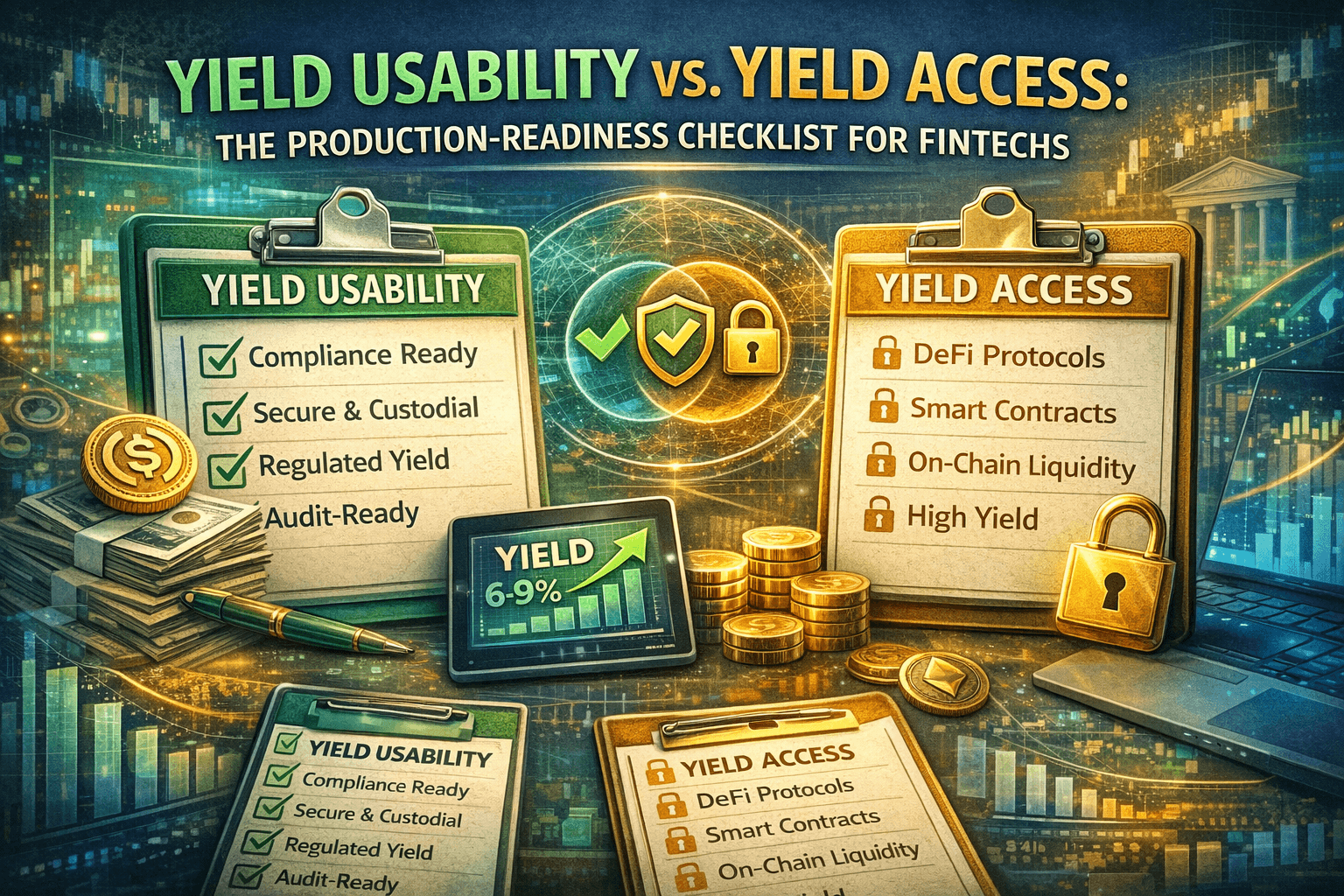
Yield access is the technical ability to connect capital to a yield source. This includes API connectivity to lending protocols, wallet infrastructure for DeFi interaction, and basic transaction execution.
Yield access answers: "Can we technically put money here and get more money back?"
Most infrastructure providers stop here. They assume connected pipes equals solved problem.
Why Access Alone Fails in Production
Access-only infrastructure creates three problems that surface only in production:
Compliance gaps: Raw DeFi yield has no built-in audit trail. "Into a liquidity pool" is not an acceptable answer for regulators. You need transaction-level provenance and deterministic flow documentation.
Operational blindness: Access tells you funds are deployed. It does not tell you current state, expected withdrawal time, or what happens if liquidity drops.
Control deficits: DeFi protocols have no SLAs, no guaranteed withdrawal windows, no granular permissions. Access without controls means you inherit all DeFi risk with none of the enterprise safeguards.
What Is Yield Usability?
Yield usability means the yield source can be safely embedded into a regulated financial product with appropriate operational controls.
Usability is defined by three components:
SLAs: Guaranteed withdrawal times, uptime commitments, defined behavior under stress
Controls: Granular permissions, policy enforcement, role-based access, programmatic restrictions
Reporting: Real-time visibility, audit-ready logs, regulatory-format exports, compliance system integration
A yield source is usable when your compliance officer can sign off without requesting custom infrastructure.
Why Yield Usability Matters in 2026
Two regulatory shifts have made yield usability mandatory.
GENIUS Act implementation (effective early 2027) prohibits stablecoin issuers from paying yield directly, creating demand for third-party yield infrastructure. But that infrastructure must demonstrate fund segregation, audit trails, and operational controls that satisfy federal examination standards.
MiCA enforcement in Europe requires crypto-asset service providers to maintain operational resilience standards, including business continuity and governance frameworks that extend to third-party yield infrastructure.
Yield access without these capabilities is not usable under current regulatory frameworks.
The Production-Readiness Checklist
Use this to evaluate whether yield infrastructure offers usability or just access.
SLA Requirements
Requirement | Access Only | Production-Ready |
Withdrawal latency | "Usually fast" | ≤30 seconds normal, ≤4 hours stress |
Uptime commitment | None | 99.9% with defined measurement |
Degradation notice | None | Proactive alerts with ETA |
Breach remediation | None | Defined compensation terms |
Control Requirements
Requirement | Access Only | Production-Ready |
Permissions | All or nothing | Role-based with granular scopes |
Deployment policies | Manual review | Programmable rules engine |
Emergency access | Unclear | Defined break-glass procedures |
Audit logging | Basic transaction log | Full action history with attribution |
Reporting Requirements
Requirement | Access Only | Production-Ready |
Position visibility | On-demand query | Real-time dashboard and API |
Transaction history | Block explorer | Structured export with metadata |
Regulatory formatting | DIY | Pre-built for common frameworks |
Compliance integration | None | Webhook and API support |
Fail more than two items on any checklist = access without usability.
Who Needs Yield Usability?
Access alone is sufficient for:
Treasury operations where the fintech is the only user
Non-regulated entities in permissive jurisdictions
Proof-of-concept deployments
Usability is required for:
Any yield-bearing product offered to customers
Any operation subject to banking, payments, or securities regulation
Any deployment where withdrawal latency affects customer experience
How to Evaluate Yield Infrastructure
Focus questions on usability, not features.
Ask about SLAs:
What is guaranteed withdrawal latency under normal and stress conditions?
How are SLA breaches measured and remediated?
Ask about controls:
Can we enforce deployment policies at the infrastructure level?
What is the emergency withdrawal procedure?
Ask about reporting:
Can we export transaction history compatible with our accounting system?
What compliance metadata is captured with each transaction?
If answers are vague, you are looking at access infrastructure marketed as a complete solution.
How Usable Yield Infrastructure Works
The pattern among infrastructure providers building for regulated fintechs includes:
Abstraction layers separating fintechs from direct protocol interaction. The infrastructure handles protocol selection and risk monitoring, exposing only needed controls.
Policy engines enforcing compliance rules at the infrastructure level. Deployment rules and jurisdiction restrictions are configured once, enforced automatically.
Reporting pipelines capturing compliance metadata at transaction time, making audit preparation a query operation rather than reconstruction.
SLA contracts with measurable commitments and remediation terms, shifting risk from fintech to infrastructure provider within agreed parameters.
Infrastructure providers like RebelFi have implemented this pattern, treating yield as one component of a broader stablecoin operations layer rather than a standalone product.
Summary
Yield access is the technical ability to connect capital to yield. Yield usability is the ability to safely embed that yield into a regulated product.
The difference is SLAs, controls, and reporting.
When evaluating yield infrastructure, ask about withdrawal guarantees, policy enforcement, and reporting integration. If the answers are vague, you have access without usability.
Production-readiness is not about APY. It is about whether compliance can sign off.