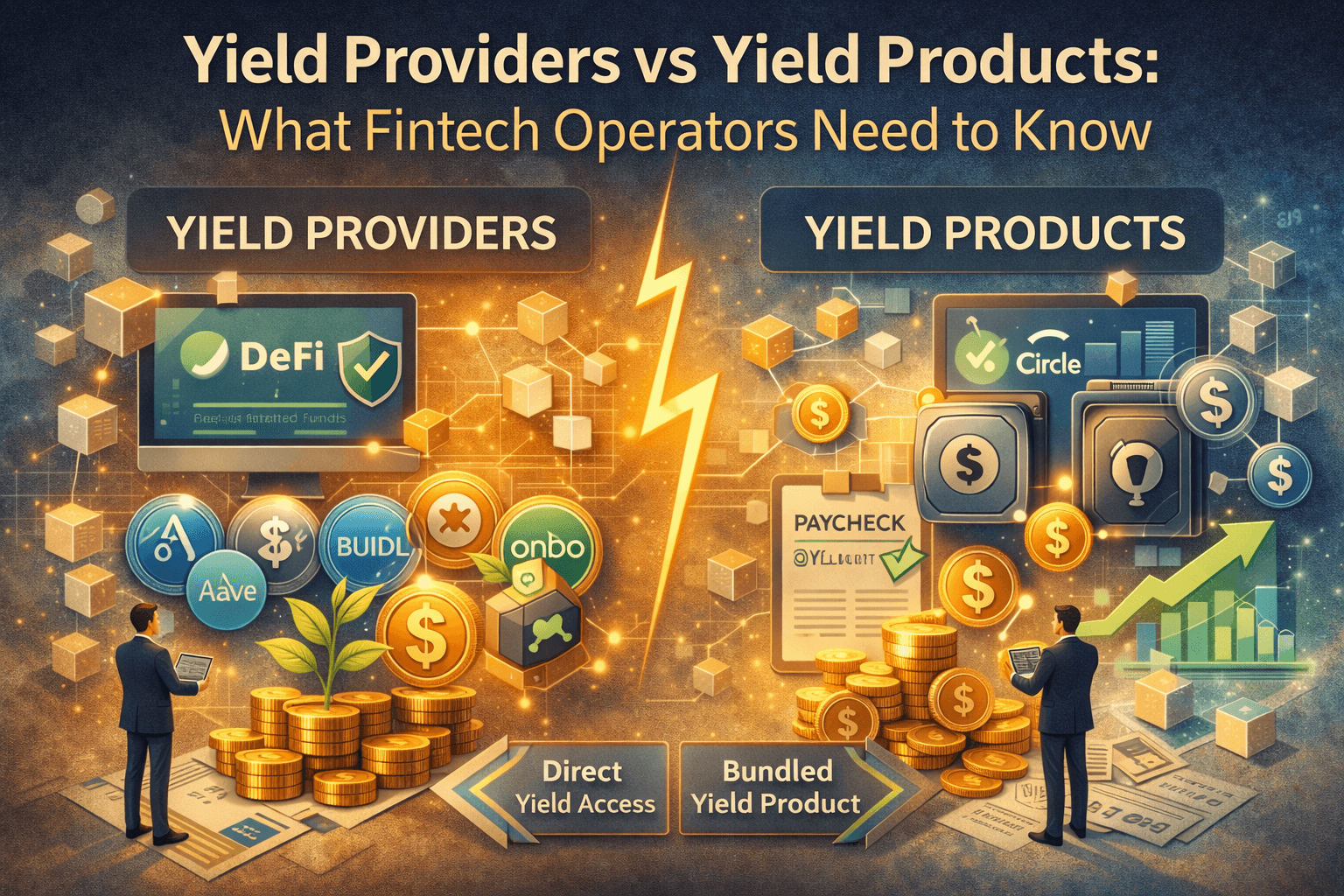
Most fintech operators assume connecting to a yield protocol is the same as running a yield operation. It's not.
A yield provider gives you an API. A yield product gives you an API plus the risk management, compliance infrastructure, and monitoring required to generate yield inside a regulated business.
This distinction matters in 2026 because stablecoin operations are now regulated. MiCA is live. The GENIUS Act is implemented. The question is no longer "can we generate yield" but "can we generate yield without breaking compliance, losing funds to smart contract risk, or creating audit problems."
What Is a Yield Provider?
A yield provider is infrastructure that connects your application to yield-generating DeFi protocols through an API.
What yield providers do:
Connect to lending protocols (Aave, Morpho, Compound)
Handle transaction construction and submission
Return yield rates and APY data
Abstract protocol-specific complexity
What yield providers do not do:
Monitor protocol health
Implement risk management
Provide compliance infrastructure
Manage wallet segregation or fund provenance
Generate audit-ready reporting
A yield provider is a pipe. It moves funds into protocols and back out. Nothing more.
What Is a Yield Product?
A yield product wraps yield generation inside operational, compliance, and risk management systems.
What yield products include:
Everything yield providers do, plus:
Continuous protocol health monitoring
Automated risk scoring and concentration limits
Wallet ring-fencing and KYT integration
Automatic quarantine of flagged transactions
Audit trails for every fund movement
Emergency liquidation procedures
Liquidity guarantees with defined withdrawal windows
A yield product treats yield as one component of a larger operational system. Generating yield is easy. Generating yield safely and compliantly at scale is hard.
Yield Providers vs Yield Products: Key Differences
Dimension | Yield Provider | Yield Product |
Primary function | Protocol access | Operational yield infrastructure |
Risk management | None | Monitoring, diversification, circuit breakers |
Compliance | None | KYT gating, wallet segregation, audit trails |
Fund provenance | Not tracked | Full chain of custody |
Liquidity | Protocol-dependent | Enforced withdrawal windows |
Emergency procedures | None | Automated unwind and failover |
The difference is architectural. A yield provider cannot be upgraded into a yield product by adding features. The product must be designed from the start for operational reality.
Why Not Just Use a Yield Provider?
You can. But doing so creates gaps that become problems under regulation.
Compliance exposure: Funds returning from DeFi pools carry provenance from unknown sources. Without KYT checks between protocol withdrawal and operational use, your wallet's risk score degrades. This triggers scrutiny from banking partners and exchanges.
Smart contract risk: DeFi protocols have been exploited for billions. Using a yield provider directly means absorbing full protocol risk with no monitoring, concentration limits, or automatic withdrawal triggers.
Operational burden: Using yield providers directly means building your own monitoring, alerting, compliance checks, and emergency procedures. For most operators, this diverts resources from core product work.
Regulatory requirements: The GENIUS Act prohibits stablecoin issuers from offering yield. Banks cannot pay interest on stablecoin custody. Third-party yield infrastructure must fill this gap, and it must be compliant by design.
When to Use Each
Use a yield provider if:
You have dedicated DeFi engineering and compliance teams
Yield is your core business
You can build and maintain monitoring infrastructure indefinitely
You operate in unregulated jurisdictions
Use a yield product if:
You are a fintech, payment processor, or financial institution
Yield is a feature, not your core product
You face regulatory compliance requirements
You need audit-ready reporting without building it yourself
What Does a Yield Product Add?
Five categories of infrastructure separate products from providers:
Risk management: Protocol health monitoring, concentration limits, circuit breakers, emergency withdrawal procedures.
Compliance: KYT checks at every fund transition, wallet ring-fencing, automatic quarantine, Travel Rule metadata, audit trails.
Operational controls: Role-based access, multi-signature requirements, policy engines, reconciliation systems.
Liquidity management: Withdrawal time guarantees, liquidity buffers, automatic routing to maintain SLAs.
Integration: Single API across multiple protocols, custody-agnostic architecture, white-label capability.
How Companies Are Implementing This
The yield product category is emerging. Most companies either use yield providers directly or avoid yield entirely due to complexity.
Companies building yield products share common patterns: separation of yield infrastructure from customer operations, KYT integration at every transition, protocol-specific wallets that isolate risk, and compliance-first architecture.
RebelFi's platform is one example, providing custody-agnostic yield optimization with integrated compliance and risk management. Partners maintain custody while Midas provides the orchestration layer.
Questions to Ask When Evaluating Yield Infrastructure
Risk: What happens if a protocol is exploited? How is concentration managed? What monitoring runs continuously?
Compliance: How are KYT checks integrated? What audit trails exist? Can compliance metadata be embedded?
Liquidity: What are withdrawal time guarantees? What happens if a protocol becomes illiquid?
Integration: Does it work with your custody provider? How complex is integration?
If the answers are "build it yourself," you are evaluating a yield provider. If the answers describe built-in systems, you are evaluating a yield product.
Summary
Yield providers give you protocol access. Yield products give you operational yield infrastructure.
For most fintech operators, yield products are the pragmatic choice. Yield is valuable. Yield operations are complex. Buying the complexity is cheaper than building it.