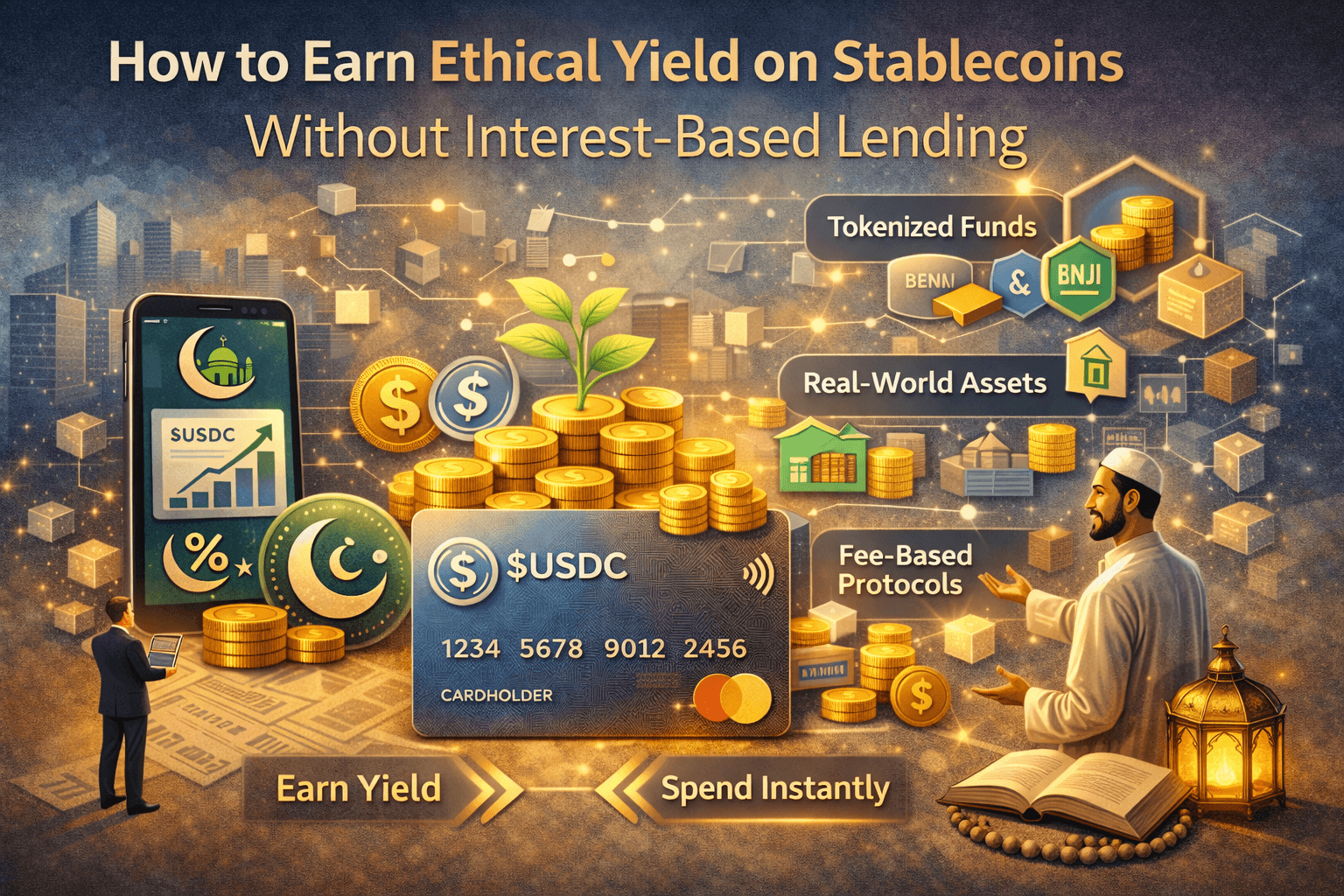
Most stablecoin yield comes from interest. Someone borrows your USDC, pays interest, you receive a cut. This is the dominant model across Aave, Compound, Nexo, and most yield aggregators.
For billions of dollars in operational capital, this model is off the table.
The restriction is ethical, not regulatory. A significant segment of global finance prohibits participation in interest-based lending. The principle governs approximately $4 trillion in assets under management across the Middle East, Southeast Asia, and Africa. Until 2025, this capital had no path to stablecoin yield.
That changed. A distinct infrastructure category emerged: yield from fees and profit-sharing rather than loan interest.
What Makes Stablecoin Yield "Ethical"
Ethical yield means returns generated without interest-based lending.
The distinction: interest treats money as something that grows automatically over time simply for being loaned. The ethical objection is that returns should come from productive economic activity, not from time-value on debt.
For stablecoin yield, compliance requires three conditions:
No interest (riba): Returns cannot derive from loans. This excludes most DeFi lending protocols.
No excessive speculation (gharar): This limits algorithmic stablecoins, leveraged positions, and certain derivatives.
Asset-backed or profit-sharing: Returns must flow from real activity: service fees, profit participation, or asset rental.
Why Most Stablecoin Yield Fails
The dominant 2025-2026 yield sources are structurally interest-based:
DeFi lending protocols (Aave, Compound, Morpho) lend your deposits to borrowers who pay interest. The mechanism is lending, regardless of terminology.
Centralized platforms (Nexo, Ledn) deploy deposits into loan products. Same mechanism.
Yield-bearing stablecoins (USDY, some DAI configurations) generate returns from interest on government debt.
Delta-neutral strategies (Ethena) derive yield from funding rate arbitrage in perpetual futures. This involves speculative derivatives.
These yields are real (4-12% APY). The mechanism disqualifies them.
Three Yield Mechanisms That Work
Fee-Based Liquidity Provision
The cleanest model. A decentralized exchange charges fees on swaps. Liquidity providers receive a share of those fees.
How it works: Deposit stablecoins into an AMM pool. When traders swap through that pool, you receive pro-rata fee revenue. No lending involved.
Current yields: 2-8% APY on stablecoin pairs, depending on volume.
Why it's compliant: You provide a service (liquidity) and receive payment for that service. Returns depend on trading activity, not loan interest.
Protocols: Curve Finance, Uniswap v3 (stablecoin pools), Raydium, Aerodrome.
Key advantage: Stablecoin-to-stablecoin pools have minimal impermanent loss because both assets track the same price.
Profit-Sharing Arrangements
Capital is deployed into productive ventures. Returns are distributed based on actual profits.
How it works: A manager deploys stablecoin capital into yield activities. Profits (if any) are split according to a pre-agreed ratio. If no profit, no return.
Current implementations: Binance "Sharia Earn" (certified by Amanie Advisors), emerging GCC-focused protocols.
Yields: Variable. Typically 4-10% when profitable, zero during unprofitable periods.
Why it's compliant: Risk is shared. Returns are tied to economic outcomes, not guaranteed by debt contracts.
Protocol Revenue Distribution
Some protocols distribute trading revenue to token stakers. This is a dividend, not interest.
Examples: Aerodrome distributes 100% of fees to governance participants. Banana Gun distributes 40% of bot fees to stakers (~19% APY currently).
Why it's compliant: Returns come from business revenue, not lending.
Who Needs Ethical Stablecoin Yield
Institutional operators in GCC and Southeast Asia: Sovereign wealth funds and corporate treasuries with ethical mandates cannot use conventional DeFi.
Payment platforms with constrained user bases: Fintechs serving regions where users require compliant products.
Operational treasury teams: Companies holding stablecoin float during payment windows, escrow periods, or pre-funding cycles.
A fintech processing $50M weekly holds significant idle capital. A marketplace with escrow requirements has float during dispute windows. This capital can now earn returns without interest-based lending.
What to Evaluate
What is the yield source? "DeFi yield" is not an answer. "Pro-rata share of AMM trading fees" is an answer.
Who certified compliance? Recognized advisory firms (Amanie Advisors, AAOIFI-aligned bodies) provide verification. Self-attestation is insufficient.
What happens during low volume? Fee-based yields should approach zero when trading slows. Claims of stable 8% regardless of conditions suggest blended interest sources.
How fast can you withdraw? Operational capital needs instant access. Lock-up periods do not work for treasury use cases.
Constraints and Tradeoffs
Lower peak yields: Interest-based lending can reach 15-30% APY during high demand. Fee-based yields typically cap at 5-10%.
Volume dependency. No trading volume means no fees. Returns are not guaranteed.
Verification burden: Protocols change. Ongoing diligence is required to maintain compliance.
Scholarly variance: Different advisory bodies reach different conclusions on specific protocols.
Implementation
Direct integration: Build in-house capability to deploy into fee-generating protocols. Requires DeFi engineering expertise.
Infrastructure-as-a-service: Partner with providers (like RebelFi) that offer compliant yield within broader stablecoin operations platforms. The provider handles protocol integration and compliance verification.
Certified products: Invest in pre-packaged products carrying advisory certification. Emerging primarily in GCC markets.
Summary
Ethical stablecoin yield is structurally different from conventional DeFi. It excludes interest-based lending and derives returns from fee revenue, profit participation, and protocol dividends.
The market is large and underserved. Billions in stablecoin capital cannot use conventional yield due to ethical constraints. Fee-based infrastructure creates the first viable path for this capital.
Yields are lower. Complexity is higher. But for capital that requires compliance, these are the only mechanisms that work.