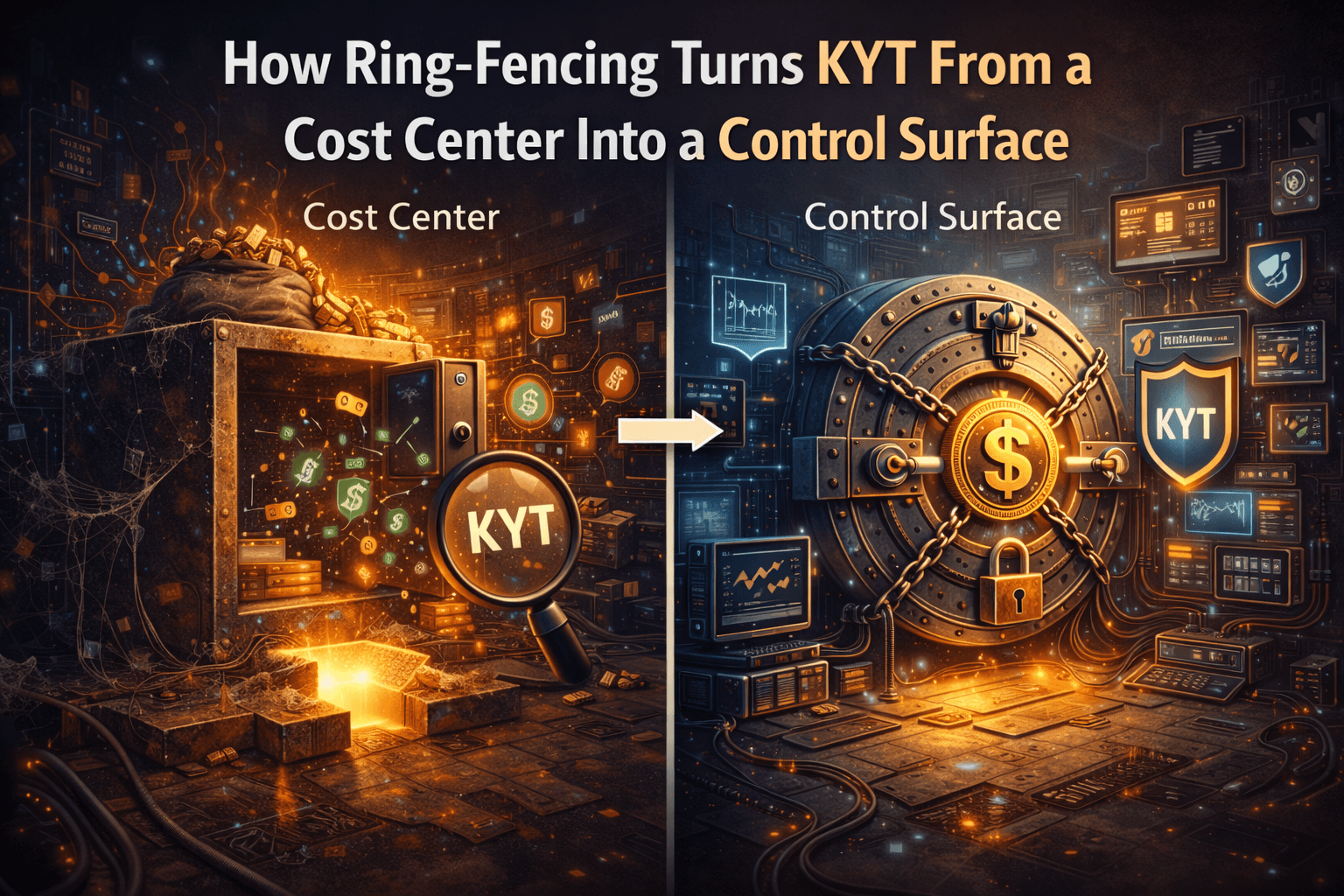
Most compliance teams treat Know Your Transaction (KYT) as a checkbox. They plug in Chainalysis or Elliptic, get alerts, and react. The system tells them something is wrong after the fact, then they scramble.
This is backwards.
The problem is not the KYT tool. The problem is where KYT sits in the architecture. When transaction monitoring is bolted onto an undifferentiated wallet structure, every alert triggers the same response: freeze everything, investigate manually, hope the contamination is contained.
Ring-fencing inverts this. Instead of KYT being a passive sensor, it becomes an active control surface. Compliance logic determines how money moves, not just whether an alert fires. The result is deterministic audit trails, isolated failure domains, and programmable escalation.
In 2026, this distinction matters because of three converging pressures. The GENIUS Act requires stablecoin operators to prove fund segregation and wallet hygiene. MiCA mandates Travel Rule compliance at the transaction layer. And institutional DeFi access demands that treasury operations interact with lending protocols without contaminating customer funds.
The operators who treat KYT as infrastructure, not overhead, will handle these requirements without breaking their operational tempo. Everyone else will be stuck in reactive mode, explaining to regulators why a $10 dusting attack froze $10 million in customer funds.
What Is Ring-Fencing in Stablecoin Operations?
Ring-fencing is a wallet architecture that segregates funds by function. Each layer has one purpose. Money flows uni-directionally through the stack with KYT gates between each transition.
The canonical implementation uses five layers:
Layer 1: Customer Deposit Addresses. One address per deposit. Public-facing. Receives both clean and tainted inflows. Never interacts with DeFi or yield protocols.
Layer 2: Operational Hot Wallets. Sweeps deposits and consolidates balances. First-pass KYT screening. Still prohibited from DeFi interaction.
Layer 3: KYT Clean Room. The first ring-fenced environment. Only receives from internal operations or approved custody. All inbound transactions must pass KYT verification before funds move forward.
Layer 4: Institutional Treasury Wallets. Holds institution-owned capital only. 100% provenance-clean. Never receives external inbound transfers. This is the entry point for DeFi interaction.
Layer 5: DeFi Interaction Wallets. Protocol-specific. One wallet per venue (Aave, Morpho, Compound). Outbound only to protocol contracts or treasury wallets. Inbound only from protocol contracts or treasury wallets. Never touches customer addresses directly.
This structure is not theoretical. Coinbase Institutional, Anchorage, Fireblocks clients, Copper, and FalconX all use variations of this architecture to safely access DeFi yield while maintaining regulatory compliance.
Why Does Traditional KYT Fail at Scale?
Traditional KYT treats transaction monitoring as an alert system. Funds arrive. The system scans them. If something looks suspicious, an alert fires. A human reviews it. Maybe funds get frozen.
This model has three structural weaknesses.
Contamination scope is undefined: When a wallet receives a flagged transaction, what happens to the other funds in that wallet? In a flat wallet structure, the answer is unclear. Conservative compliance teams freeze everything. This means a $10 inbound from a mixer can immobilize millions in legitimate operational capital.
Escalation is manual: Alerts require human review. Humans require time. During that time, operations either stop or proceed at risk. There is no middle ground. You cannot programmatically route suspicious funds to quarantine while keeping clean funds flowing.
Audit trails are reconstructed, not native: Regulators want to see fund provenance. With undifferentiated wallets, proving that specific outbound funds came from specific clean inbound funds requires forensic analysis. This is expensive and time-consuming. It also fails when regulators ask questions about flows that happened months ago.
The root cause is architectural. Traditional KYT sits beside the money flow. Ring-fencing puts KYT inside the money flow.
How Does Ring-Fencing Change the KYT Model?
Ring-fencing transforms KYT from a sensor into a gate. Funds cannot move between layers unless KYT passes. This is not a policy choice. It is enforced by the architecture itself.
Three capabilities emerge from this design.
Deterministic Audit Trails
Every transition between layers is logged with a KYT determination. The trail is not reconstructed after the fact. It is generated as funds move.
When a regulator asks "show me the provenance of this outbound transaction," the answer is immediate. You can trace the funds backward through each layer: customer received these funds at L1, they passed KYT and moved to L2, they passed KYT again and entered L3, they were allocated to treasury at L4, deployed to DeFi at L5, returned with yield to L4, and finally paid out through L2 and L1.
Each step has a timestamp, a KYT determination, and a state transition. There is no ambiguity.
Isolated Failure Domains
If a flagged transaction hits L1, it does not contaminate L2. It does not freeze L4. It does not halt DeFi operations at L5.
The key principle: taint is tracked at the transaction level, not the address level. One bad inbound does not poison the entire wallet. Only that specific flow gets flagged.
Flagged funds route to a quarantine wallet. They never mingle with operational capital. The compliance team reviews them separately while the rest of the system continues operating.
This is why institutions can safely accept arbitrary inbound transfers on public blockchain addresses. Anyone can send USDC to any address. With ring-fencing, this is a minor operational event, not an existential compliance risk.
Programmable Escalation
Different risk scores can trigger different responses. This is not manual triage. It is configured policy.
Low-risk transactions pass automatically and move to the next layer.
Medium-risk transactions route to a review queue but do not block the address.
High-risk transactions quarantine immediately and trigger alerts.
Severe-risk transactions (known sanctions addresses, confirmed hacks) can trigger automatic rejection and reporting.
The compliance team sets the thresholds. The system enforces them. Humans review edge cases. The 90% of transactions that are clearly clean or clearly problematic never require human attention.
What Are the Three Control Surfaces Ring-Fencing Creates?
Ring-fencing turns KYT into a control plane with three distinct surfaces: intake, internal routing, and outbound distribution.
Intake Control Surface
At Layer 1 and Layer 2, KYT determines what enters the system. This is where you filter external risk.
Every deposit gets scanned. Clean funds proceed to L3. Flagged funds route to quarantine. The decision is made before funds touch any operational wallet.
This is the first line of defense. It prevents contamination from ever entering the clean portion of the architecture.
Internal Routing Control Surface
Between L3 and L5, KYT governs how funds move between your own wallets. This is where you enforce operational policy.
Want to limit DeFi exposure to 20% of treasury? Enforce it at the L4 to L5 transition. Want to allowlist only specific protocols? Check at the L5 outbound. Want to trigger rebalancing when yield rates change? Gate on market conditions.
This control surface is underutilized. Most operators think of KYT as external-facing only. But the same infrastructure can enforce internal treasury rules, compliance limits, and risk budgets.
Outbound Distribution Control Surface
At L1 outbound, KYT validates where funds go. This is where you protect downstream counterparties and yourself.
Before any customer withdrawal, the destination address gets checked. If the recipient address is flagged, the withdrawal blocks. This protects you from inadvertently paying a sanctions entity.
It also creates the provenance that downstream recipients need. When your customer receives funds from your operational wallet, they see a clean institutional source. They do not see "funds from Aave pool with mixed provenance."
The multi-layer routing breaks the taint chain. By the time funds reach the customer, they have passed through multiple KYT gates and carry institutional provenance.
Who Needs This Architecture?
Four categories of operators require ring-fencing to operate compliantly at scale.
Fintechs processing stablecoin payments: If you accept customer deposits and make customer payouts, you need segregation between customer funds and treasury funds. If you also generate yield on treasury, you need segregation between yield operations and customer operations.
Exchanges and OTC desks: Customer deposits must never touch DeFi. Customer withdrawals must have clean provenance. Treasury operations must be auditable. This is the minimum for any licensed entity handling customer assets.
Payment processors and on-ramps: High volume means high exposure to random inbound. Without ring-fencing, a single bad transaction can create operational chaos. With ring-fencing, it is a routine quarantine event.
Any institution accessing DeFi yield: Regulators understand that DeFi pools contain funds from unknown sources. They accept institutional DeFi access only when the institution demonstrates that customer funds never touch the pools and that returns are cleaned through institutional provenance before reaching customers.
What Are the Tradeoffs?
Ring-fencing is not free. Three costs must be weighed against the benefits.
Operational complexity: Five wallet layers require more infrastructure than a single hot wallet. Each layer needs key management, monitoring, and failover. This is engineering overhead.
Gas costs on multi-transaction flows: Moving funds through multiple layers means multiple on-chain transactions. On Ethereum mainnet, this is expensive. On Solana or L2s, it is negligible. Architecture should match the deployment chain.
Capital efficiency delay: Funds do not move instantly from deposit to yield deployment. Each KYT gate adds latency. For high-frequency operations, this matters. For daily or weekly treasury operations, it does not.
Most operators find the tradeoffs acceptable because the alternative is worse. Operating without ring-fencing means operating without deterministic compliance. In 2026, that is not a viable position for any regulated entity.
How Is This Being Implemented Today?
Several approaches exist for implementing ring-fenced KYT architecture.
Manual policy configuration: Operators using Fireblocks or similar custody platforms can configure wallet policies to enforce segregation. This works but requires significant setup time and ongoing maintenance. Each policy rule must be manually defined and tested.
Turnkey infrastructure: Platforms like RebelFi provide ring-fencing as built-in architecture. The five-layer structure is pre-configured with KYT gates at each transition. Operators configure thresholds and policies rather than building the infrastructure themselves.
Custom smart contract integration: Some operators embed KYT directly into escrow contracts. Funds cannot move unless a KYT oracle confirms the transaction is clean. This is the most programmable approach but requires smart contract development expertise.
The trend is toward infrastructure that abstracts the complexity. Compliance teams should not need to understand OOXML or smart contract ABIs. They should set policies and have the architecture enforce them.
Why Does This Matter for Stablecoin Operations Specifically?
Stablecoins create unique compliance requirements that traditional KYT does not address.
Anyone can send to your address: Unlike traditional banking where you control who can credit your account, blockchain addresses are public. Dusting attacks, accidental sends, and deliberate contamination attempts are routine. Ring-fencing makes these events manageable.
DeFi interaction is expected: Institutional stablecoin holders want yield. Yield comes from DeFi. DeFi pools contain unknown counterparties. Ring-fencing is the only architecture that permits DeFi access while maintaining customer protection.
Travel Rule applies: Under GENIUS and MiCA, stablecoin transfers above certain thresholds require sender and recipient identification data. This data must travel with the transaction. Ring-fencing architectures can embed this metadata at each layer transition, creating Travel Rule compliance by default.
Regulators audit addresses, not just entities: When a regulator examines a stablecoin operation, they trace on-chain activity. Ring-fencing creates clean, auditable patterns. Undifferentiated wallets create explanatory overhead.
What Questions Should You Ask Your Infrastructure Provider?
If you are evaluating stablecoin infrastructure, these questions reveal whether the provider understands ring-fencing:
How are customer funds segregated from treasury funds? The answer should describe specific wallet layers, not just "we keep them separate."
What happens when a flagged transaction arrives? The answer should describe automatic quarantine and isolated failure domains, not just "we get an alert."
Can I configure escalation thresholds? The answer should describe programmable policies, not just default settings.
How do you handle DeFi interactions? The answer should describe protocol-specific wallets that never touch customer addresses.
Show me an audit trail for a complete fund cycle. The provider should be able to trace any transaction from inbound to outbound with KYT determinations at each step.
Key Takeaways
KYT as currently deployed at most institutions is a sensor. It tells you what happened. It does not control what happens.
Ring-fencing transforms KYT into a control surface. Funds move only when KYT approves. Contamination is isolated by design. Audit trails are generated, not reconstructed. Escalation is programmable, not manual.
This is not incremental improvement. It is architectural transformation. The operators who implement this now will operate compliantly at scale. The operators who do not will spend their time explaining why compliance was reactive instead of deterministic.
The infrastructure exists. The regulatory requirements demand it. The only question is whether you build it yourself or use infrastructure that provides it by default.